
In 2023 and 2024, local poets, practitioners, staff and students from the University of York and volunteers from St Nick’s thought collaboratively in a series of experimental eco-poetry workshops, resurfacing some of the unseen history of St Nicholas’ Fields. Thinking from the Middle Ages to the present day, we used poetry as a medium for this revoicing. The following essay reflects on my own medieval-contemporary relationship with water in the city of York, drawing on acts of revoicing begun in those workshops. With thanks to practitioners Bryony Aitchison, Tom Branfoot, Francesca Brooks, Susie Campbell, Anthony Capildeo and Jessie Summerhayes.
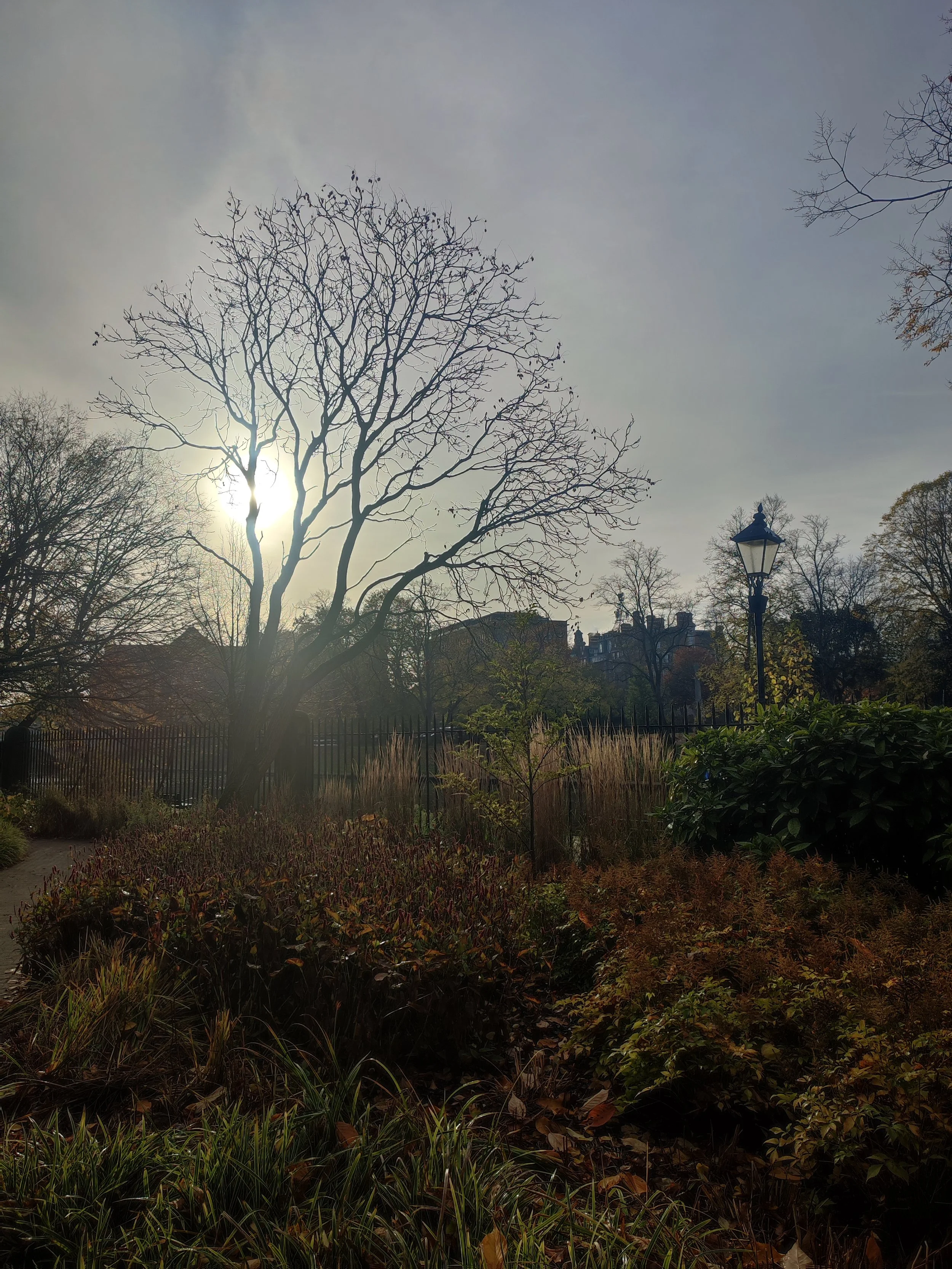
In this city, time measures itself as water staining dark the arches under Lendall Tower. If the water runs low, time lazes along. Families wander the length of Dame Judy Dench Walk holding ice creams. If the water runs high, barely any stone showing above it, then people hurry over Lendall Bridge, burying heads in hoods (umbrellas are no use against the wind), digging hands in pockets for a few seconds more of warmth on their way to work, the shops, wherever they are going to get out of the rain.
Today, time is panicked. I draw the cords of my hood tight beneath my chin and pelt across Lendall Bridge towards the city library. The water has come up from the river and down from the sky. There is no escaping it. By the time I pass through the hot blast of the library doors I am soaked through.
The library is full to bursting. Finding nowhere to sit except for a damp grey armchair, I perch, looking around me at the other people who have chosen to visit the library this first Monday in September. A Middle-Aged woman wrapped in a dark-stained raincoat, coughing. An old man fidgeting in the corner. Lines of students hunched over laptops at the reading room desks, eyes staring dead ahead.
I open the book of poetry I have borrowed from the shelves downstairs and begin to read. It is a book about dialect, the historic languages of a place bubbling up like water through cobblestones and pooling unexpectedly in the structures of today. In my head, like tinnitus, the latest conversation with my dad, in which I told him I was keeping warm but it was raining and I was finding increasingly creative ways to keep the water from coming in at the window of my flat; he told me about the potholes appearing like whack-a-mole along the village road. If I close my eyes, I can see him walking up and down this lane, counting the water-filled ruts like syllables in a difficult word.
I’m supposed to be writing about water. Its medieval courses, deviations through time, submergences and reemergences. But my focus keeps straying. This, too, is like water. In this city, water never stays put. You can measure your life against whether it is up or down, hidden or laying itself belly up across the pavement in the middle of where you are walking. I often walk home along the river path and have lost count of the times the water, rising, has rerouted me.
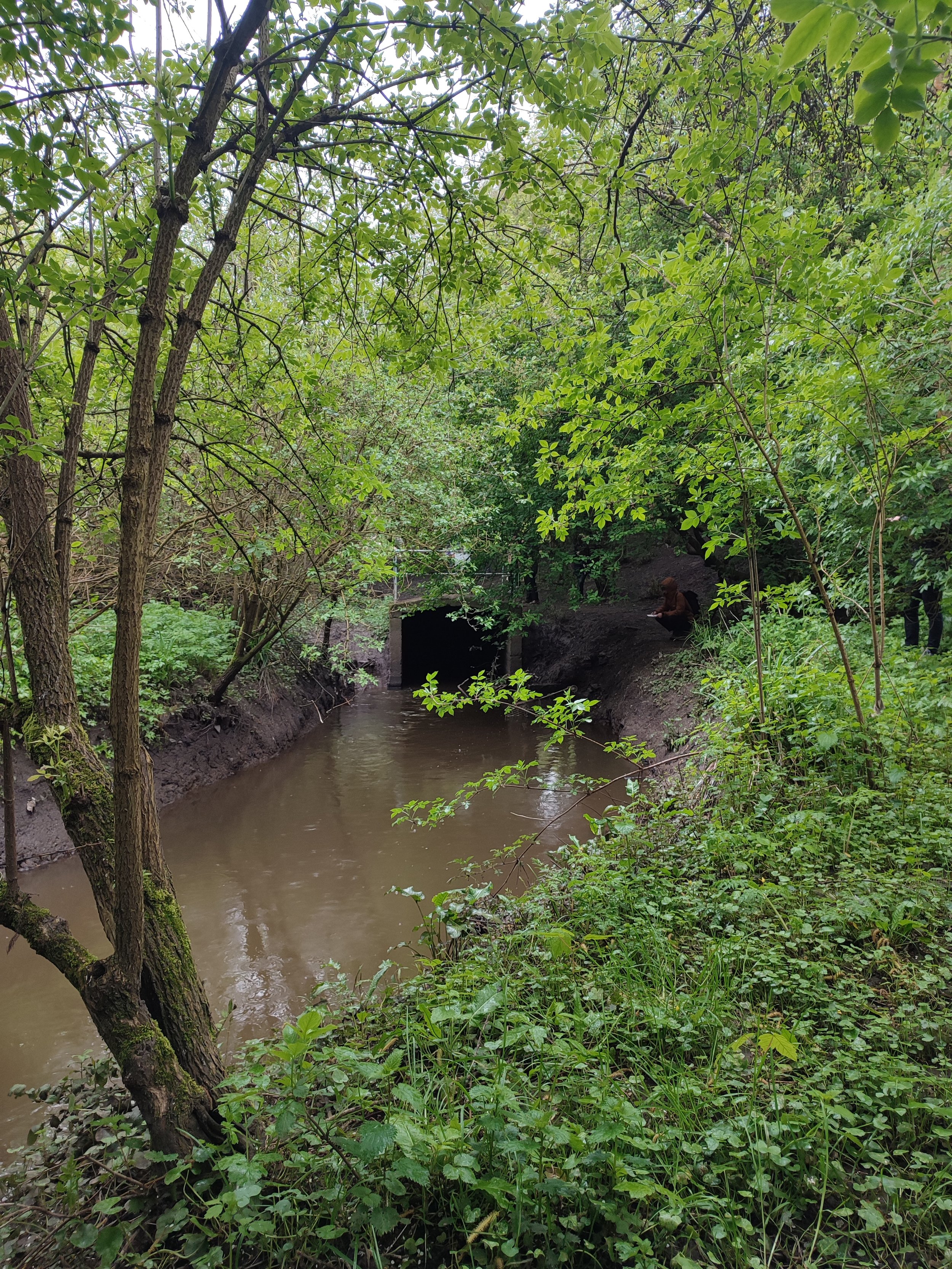
I’m supposed to be writing about where the River Ouse via the River Foss meets Tang Hall Beck and Osbaldwick Beck in culverted windings on the stray at St Nicholas’ Fields.
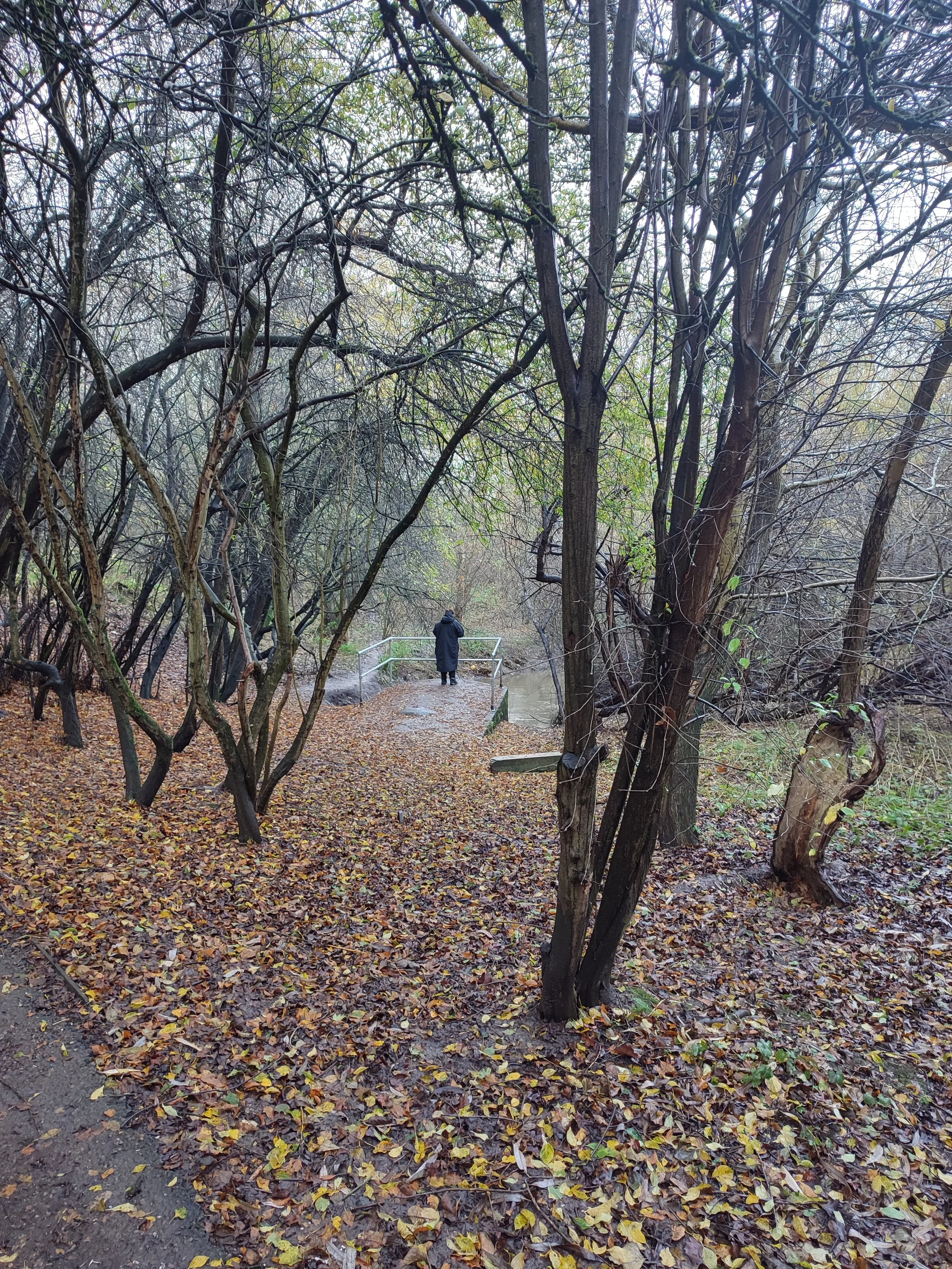
Now a nature reserve of tangled thickets and apple trees, St Nicholas’ Fields has had many uses since the Middle Ages. It has been hospital, fishpond, marsh, meadow, and landfill. It has given rise to fish and field, industrial waste and apple trees, make-shift tyre gymnasiums and landscaped parks created for post-war civil recreation. The walled city of medieval York incorporated areas of common land used for grazing animals, and in some cases for agriculture.[1] These pasturages, perhaps owing to the wandering animals temporarily inhabiting them throughout the year, were called ‘strays’. Though not technically one such area of common land, since St Mary’s Abbey gave it over to its first use as a hospital for lepers in the thirteenth century, the land at St Nicholas’ Fields might, in its shifting nature of use, also be called a ‘stray’.[2] It is one of those landscapes that is hard to pin down, absorbing many layers of history that, although unseen, lie beneath the surface just out of touch.
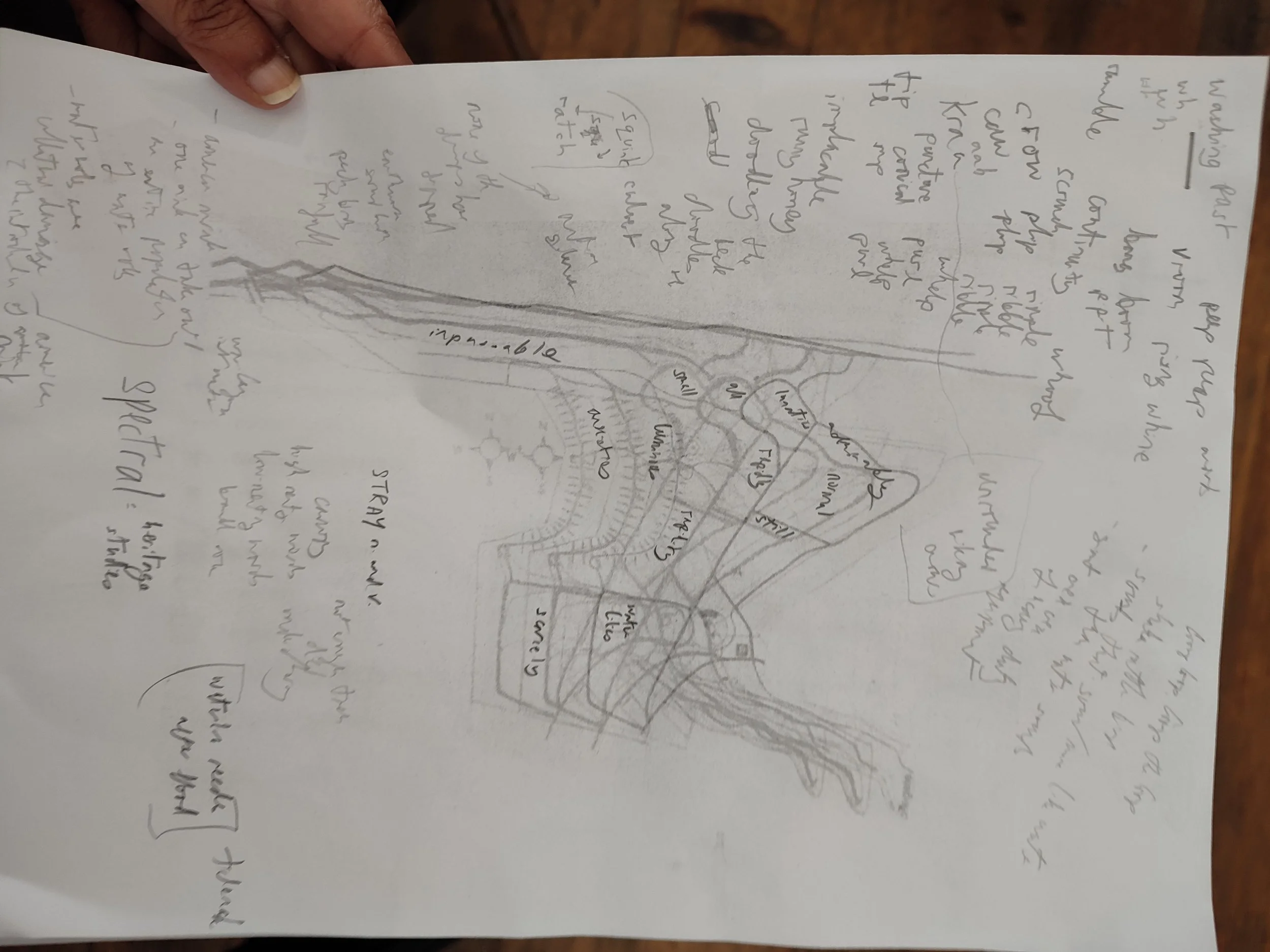
There is not much about St Nicks in the historical record, meaning its environmental history must be built of gaps or cracks in the ground. Briefly, myself and others thought to fill these gaps. We listened concentrically (Capildeo). We sought a continuous aqueous tense, writing with and like water (Branfoot). We observed the past and present of the site on macro and micro scales (Brooks, Aitchison). We centred waste as a liquid language to call up the medieval pasts of St Nicks (Campbell). We let water in its various forms voice a history of the in-between.
In the city library, in a damp chair, I start to write.
Winding beneath supermarkets, a mosque, and residential rows on the outskirts of York, Tang Hall Beck and Osbaldwick Beck run culverted. Through these unseen water courses, the landscapes of the past leak into the landscapes of the present. They are broken apart, divided up, recollected and eroded. They gather, are redistributed, silt up and are added to. A multitemporal hydrocommons with no one part fixed in place.
I think about the ways landscape follows us around. I am sat writing in a chair in the city library, the rain clinging to my clothes. There is nothing to tell me what time of day it is, how much time has passed, other than the movements of the other people sitting in the library. Cough, fidget, eyes dead ahead. For a time, I could be anywhere, anytime, but I am here dragging my mind back through centuries. I am not, and could never be in medieval York, its floodwaters, rains and mud. I imagine my chair floating on the waters of the Ouse, backwards, forwards. Floating around on the floodplain. It has only recently been sculpted out of the flattened Forest of Galtres, and if I turn my head, I can see the beacon light of All Saints Pavement church tower guiding walkers through the forest after nightfall. I am not there but here, now, in my chair, borrowed for a morning. But if I stepped outside and craned my neck to look past buses crammed into the slow-moving junction outside the old customer information centre, I might just see the light at the top of the Minster, blinking through the scaffolding. I imagine holding the landscape of the present equally with the landscape of the past, like two rivers flowing, like the Rivers Ouse and Foss intermingling below the blue bridge south of Cliffords Tower, the old King’s Pool. The water is in my skin. In an act of analogue rebellion, I have started taking notes in fountain pen. But this pen I am writing with leaks, spreading a black ink stain pretty much permanently across my thumb tip, so that when I meet people and shake their hand, as sometimes happens, although not presently as I am sat here in the borrowed library chair and not making eye contact with my borrowed library people, who cough and fidget and stare, but if I were to leave the library and head to a pub, perhaps later in the day, perhaps when it gets dark and, guided there by a series of lights, not the church beacons leading walkers out of the forest but city lights from pubs and bars and restaurants and even the remnants of the Christmas lights left up till February, perhaps if I were there in the pub I might stop to shake someone’s hand, if I hadn’t met them before, and wonder if I had, through the ink on my hands, transferred to them palm-to-palm some part of medieval York, because I have been calling it up through writing, flowing it from page to pen to skin to skin to the person I barely know, who now holds a piece of the medieval past I have just created.
The desire to write into landscapes of the past, to call them up through water, is about touch, about being connected. That wonder feeling of being both here and there, and of understanding something greater than right now. It is enough to make one stray from the practical concerns of the present. I could do as my dad says and spend today fixing my flat’s leaky window: keep warm–keep dry–live here and now; or I could travel via the leaky hydrocommons of a pen into a feeling of being more than I am right now, of understanding that when the rain stops and the river slows I will leave this chair and this writing but remain a part of the city, its past and future, as surely as a river stain on stone.
[1] 'Common lands and strays', in A History of the County of York: the City of York, ed. P M Tillott (London, 1961), British History Online https://www.british-history.ac.uk/vch/yorks/city-of-york/pp498-506 [accessed 7 March 2026].
[2] Calendar of the Close Rolls Preserved in the Public Record Office, Edward I, A.D. 1272–1279 (Eyre and Spottiswoode: London, 1900), p.280.
Becca Drake’s Unstill Landscapes was published in 2025 by Guillemot Press and is available here.
