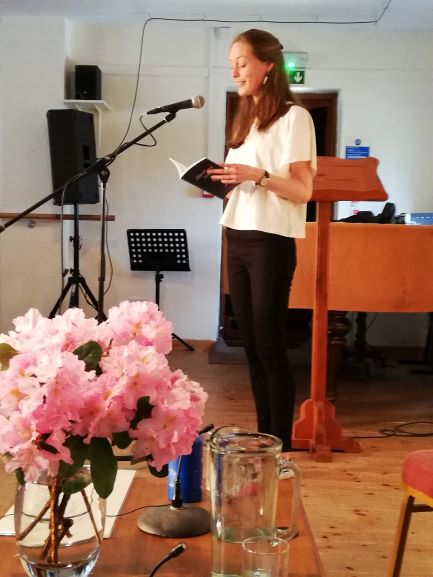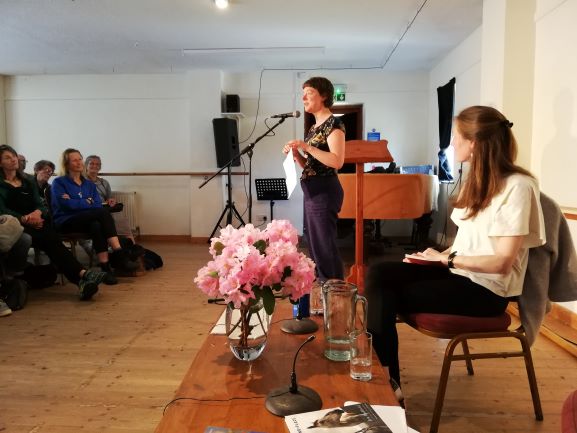
'Inhabiting a Space of Love': Cat Chong & Jen Hadfield

Cat Chong
‘Poetry permits a speaking from the margins’ has seemed a commonly accepted assertion in my life over the last few years. Typically, this referred to the margins of race, gender, class, and sexuality practicing interventions into language which enacted a speaking back, a speaking out of places of erasure. I recently read that ‘disability is the last margin to be addressed’ (Scior and Werner, 2016) and while I know this idea isn’t new I realise that while I was studying I never encountered a contemporary poetics that engaged with neurodiversity or disability.

As I was trying to counter this lack of representation within academia and poetry, I started attending events in London which spoke to my subjectivity as a poet and as a disabled individual. These were often organised and run by people like me, and I attended because I felt compelled to validate the belief that I am not alone. I wanted to be with others like me and to commune together about embodied difference in a way that didn’t feel like I had to confess anything. When I did eventually find these places, they felt like home. I felt like I belonged there. Even without a diagnosis I was able to engage with my identity as a disabled poet in a way which felt sincere. I was simply being, and that was alright.

Creating space for women interested in and sensitive to neurodiversity is the aim of The Poetic Spectrum workshop hosted by Jen Hadfield, an award winning poet who herself is neurodiverse. The workshop recognises women without a diagnosis, who identify Autistic spectrum disorders (ASD) traits in their personality, acknowledging how ASD presents differently in women than in men (and welcomes any woman who would describe herself as neurodiverse in any other way). I wanted to ask her what it’s like occupying multiple marginalities as a poet, to navigate neurodiversity and gender in a way that feels generative, to discuss some of the ways in which neurodiversity and disability overlap and intersect in poetry. I was curious about what it was like to organise safe, communal spaces and how this affected her experience of poetics and the role of the poet.

Jen Hadfield
So I notice, first of all, that you choose to describe yourself as ‘disabled’ and that you mention ‘neurodivergent poets’ – these two things aren’t necessarily connected of course.

Cat
But there are areas of commonality. As someone with a chronic illness, my disability is invisible. There’s an assumption that because I look healthy then I am healthy. This assumption is made by friends, family, and even doctors. It’s one of the reasons it’s so hard to get a diagnosis. As a result, at times I spend a great deal of time compensating for being ill.

In a seminar with Broc Rossell, he said that ‘poetry is a sensitivity to language’, and I think the same can be said of neurodiversity and disability: neurodiversity and disability can create a sensitivity to language – connecting communication, poetics, and atypical phenomenologies. To me, explaining symptoms to doctors, lecturers, and those around me involves selecting the right words in the right order, and is to be taken seriously. Having spent years without a diagnosis, narrating my own experience without a medical way to signal what it is that makes my body different, is difficult. For me, it’s hard to tell the truth when it doesn’t have a name for anyone to recognise. It took a long time for me to identify myself as disabled. The word was covered in projections of shame, most of which came from my family and those around me.

Jen
This has been quite hard for me to navigate personally and professionally (I feel quite vulnerable explaining why I describe myself as neurodiverse) so I’ve spent quite a bit of time lately unpicking why I feel like that. My way of talking about it now is this: I definitely recognise an interesting array of neurodiverse traits within myself that are often associated with Aspergers. I don’t have a diagnosis, but almost certainly should do, for reasons I won’t go into too deeply here, mostly because to do so gets too personal. I think the reason I don’t is that women present very differently and the clinical approach hasn’t quite caught up yet – something that’s been discussed a lot on Radio 4 in the last couple years. Some of these traits are difficult/uncomfortable to live with and have given me some grief over the years, although I’m relatively comfortable with them now. Others feel like genuine boons. Women work harder than men, we think, to mask such traits as don’t conform to social and cultural mores, and sometimes you don’t know you’re doing it. Have been doing it all your life. That’s hard work, and sometimes it goes wrong, and I think there is a kind of violence you can do to yourself by denying your own needs in this way. On the other hand, sometimes it means that you’re treating other people with a lot more conscious care and responsibility. Either we learn intellectually (if we choose to) how to empathise and ask questions and express our own feelings and thoughts (I shouldn’t say we, here, there’s too much variation to do that) where others do so innately, or we do it just as innately, but later … or others learn how to do it as much as we do, but earlier in life – I don’t know. Anyway, I think our feeling for folk – for example – and our care of others is no less authentic and valuable for developing in this way.

At any rate. I think that the way I want to tell my own story, and the way that feels true to me, is that rather than me being a neurodiverse person as opposed to a neurotypical person, is that maybe everyone by definition of being a person is neurodiverse in some way or another. How does that sit with you as an idea? What it gives me is dignity, of course; and it refuses the collection of paradigms that say ‘these people are more normal than these people over here’. What the massive underdiagnosis of Aspie women for example has signalled to me is that there is such a huge hidden population of people that would probably call themselves neurodiverse if they didn’t feel that was a stigmatising thing, as to probably represent a really significant chunk of the population. But then there are all these other manifestations of diversity too, so why do we insist on calling ANYONE normal? Everyone’s got something going on, right?

Cat
We all do have something going on now, with lockdowns imposed in a majority of countries, the covid-19 crisis has highlighted our reliance on community, connection, and our ability to change the way we conceive of work, especially work from home. It’s been incredible to see the speed at which the world has become more accessible now that working from home has become an everyday reality for many people. Online poetry readings have proliferated massively and the term ‘Zoom’ has just about entered the common lexicon. It does have its benefits: if a discussion feels too loud I can simply turn the volume down; only one person talks at a time; I can do poetry readings in a shirt and the comfiest trousers that no one will see; and I get to do everything from the safe space of my bedroom with the ‘End Call’ button always in front of me.

When I was doing my BA, I was told that to be involved in poetry in London meant that I had to ‘be in the room in order to be counted’. At first this frightened me because of the huge amount of energy I knew it would take me to simply be in a crowded place with so many people, but after a while I slowly started to get used to it. By the end of my MA I could attend poetry events without getting too overwhelmed. This took some practice, though it always meant spending the next day in bed utterly exhausted. So much of poetry before the lockdown felt as though it was predicated on the spaces in which it communally took place, according to who was in the room, who was there, who was able to be counted. This has changed since the lockdown and I retain the small hope that this broadening of accessibility won’t evaporate when the lockdowns lift.

Jen
So, I am very sensitive to sounds, sometimes, especially when I’m tired. Busy places tire me out and make me a bit panicky after a while, and I find it hard to think straight in those places. NOT UNUSUAL TRAITS I don’t think, even for people who wouldn’t call themselves Aspies. I find it quite hard to talk sometimes (proper tongue-tiedness) but for others it’s very easy and I can be very articulate on subjects I like talking about, if I’m relaxed with the folk I’m with. That’s about the sum of it for me, except to say that that sensitivity to sounds, smells and colours and textures can be a really delicious thing under the right conditions.

Hm, where am I going with this? Oh, the workshops. So, I wanted, yes, to create an atmosphere of inclusion and as much calm as possible. One workshop was at Glasgow Women’s Library, and they invested a lot of time in getting this right with me. We had a nice spacious quiet private room and I made sure that people knew if they wanted to pop out or leave at any moment that was absolutely fine. I took care to talk only about my own experience and that of my sister where she had ok’d that, and to not presume to know anyone else’s experience. I would say that everyone in the group willingly shared traits that they themselves defined as neurodiverse, not that they had to do that. I wanted the group to be open to women who were curious about neurodiversity as well as those who would describe themselves as neurodiverse. We all gave each other time to talk as much as we needed, and we didn’t make anyone speak before they were ready. And the focus of the writing exercises, as I remember, was on language – was on writing as we speak, as closely as possible – so celebrating the diversity of our voices, and harnessing writing’s power to get across what we most need to articulate, even when that’s difficult. It was a wonderful experience for me because I felt like everyone felt comfortable with who they were in that room and enjoyed each other. And that we valued each other’s strengths and superpowers. Glasgow’s Women’s Library also said, not only were we oversubscribed, but that normally with free weekend workshops they normally see a no-show rate of about a third. We had MORE people than were booked. They were really surprised, and I think that too points at the fact that there are a lot of people out there who have needed a different format/focus in writing workshops.

The other sessions were mostly a talk/reading kind of format, but I shared a few neurodiverse traits of my own and just asked folk to consider whether they recognised any of those traits in themselves, whether they called themselves neurodiverse or not. I was quite shocked by the number of people who came up afterwards and said they felt I was speaking very directly not only to their own experience but that of many of the people they knew. Of course, an arty crowd is sort of self-selected, often, and we’d maybe expect to see a lot of quite sensitive people there … but still, I was surprised, and it felt very positive. I did feel very nervous before some of these events. I took in feedback forms and the responses were various but mostly very warm and positive and appreciative; there were maybe just a few stupid comments like ‘lovely feminine reading’ !!!!! but everything about neurodiversity was very encouraging and actually gave me a lot more confidence to talk about this stuff. I will say that after a reading in St Andrews this week where I was quite nervous, I felt very keenly the need to develop a way of talking about this stuff that can be both professional and personal. When it feels too personal, it feels like I’m baring my soul in an unhelpfully confessional way and making myself vulnerable. When I get the balance right, I feel fine about myself and positive about my subject. I think that variability is coming from decades (or more) of stigma and misunderstanding about Aspie traits and neurodiversity though and I’m quite committed to challenging that. I feel like it SHOULD FEEL SAFE.

Cat
I’m curious what it means to speak out of difficulty. I want to think about this in relation to the poem ‘The Asterism’ in Byssus (2014) which is preceded by a quotation from Annie Dillard's A Pilgrim at Tinker Creek:

a mystery, and a waste of pain

The first line of the poem is addressed as if to an 'Inexplicable pain – / ... a thing like Sirius / or Aldebaran –'. I wonder how you navigate difficulty within the fragile structures that constitute the written and spoken word? Between ‘effortful’ and ‘proper tongue-tiedness’ and ‘sudden flu-encies' to say ‘what we most need to articulate, even when that’s difficult’?

Jen
I think I just try to be honest about them. After my reading at StAnza, a friend said she wondered how people could take on board what I was saying about struggling to speak when I was talking about it so fluently in poetry! The point is that writing a poem very practically helps you rehearse what you need to say. And say it as powerfully as possible. To score in breath when you know you will need breath. To take out clusters of sounds that are hard to say. And to self-hypnotise into a calm state where speaking is more possible. Also, I think if you can hypnotise yourself with a poem’s rhythm, you probably also hypnotise a willing audience! Then they too have the opportunity to process stuff … Perhaps …

Cat
I really appreciate this strategy for reading. I've only started to read my work publicly in the last year and I still find the prospect of pronouncing my work, out loud, quite daunting. The process of putting my body to and into a text was something I wasn’t sure I felt confident doing.

According to the National Autistic Society, ‘various studies, together with anecdotal evidence, suggest that the ratio of autistic males to females ranges from 2:1 to 16:1’. The most-up-to-date estimate is 3:1 which was found in a study by Professor Francesca Happé, the director of the Social, Genetic & Developmental Psychiatry Centre at King’s College London. Within the same study Happé and others believed the ratio could be potentially as low as 2:1 – ‘as diagnostic processes become better tailored to identifying autism in girls and women’ (Delvin, 2018).

To situate diagnosis within the realm of poetics – framing the process of diagnosis as a medical form of labelling and meaning making – spoke to the poem Love's Dog in your debut collection Nigh-No-Place (2008). The poem begins with a lucid declaration about the conflicting responses to this legibility within diagnostic identification. The poem begins with:

What I love about love is its diagnosis
What I hate about love is its prognosis

I've been thinking about this a lot; the love of a name while hating the predicted future projected by that name. Like loving a signifier and hating the signified, the poem seemed to suggest what they love about love is the sound, the word, the image of the diagnosis, whilst hating the rigid and concrete boundaries created by a prognosis’ parameters.

I think there’s a loving and hating involved in being ‘hidden’, in being invisible. I feel this a lot in relation to my own undiagnosed chronic illness but I’d never thought about it in relation to love before reading Love's Dog. I’d never thought about the invisibility inherent within an invisible disability in relation to love as an emotion, as sensation, as act, and affect. I realised that within the rigorous medicalisation of my body – in my attempts to understand what was happening to me, – that I’d internalised the loveless lexicon of medical science. I’d never thought about my body and disability as inhabiting a space of love. In reading your work, I spent a great deal of time considering the limitations of vocabularies and language itself in relation to experience. So far, I’ve found two ways to approach diagnosis as a naming; either diagnosis reduces an experience to the word or there is a failure to name.

In The Argonauts (2015) Maggie Nelson seems to describe the former when she quotes her partner Harry as saying: ‘Once we name something, you said, we can never see it the same way again. All that is unnameable falls away, gets lost, is murdered. You called this the cookie-cutter function of our minds. You said that you knew this not from shunning language but from immersion in it, on the screen, in conversation, onstage, on the page.’

Prudence Bussey-Chamberlain described the alternative, the inability to get a diagnosis viscerally as, “you are wordless expanse of affect and sensation without a name”. In my work, I've often tried to disrupt the sentence and the medical language of sickness to create a kind of rupture between the signifier and the signified in relation to chronic illness, to try and make space for my own identity as disabled without invoking the stigmas of shame and pity that are typically attached to disability. The influence of stigma seems to cause the same kind of alienation when recognising neurodiverse traits.

Jen
There is such a huge hidden population of people that would probably call themselves neurodiverse if they didn’t feel that was a stigmatising thing, as to probably represent a really significant chunk of the population

Cat
I think both neurodiversity and disability find an alliance through poetics, in the poem’s ability to intervene into the language of diagnosis, prognosis, and scientific discourse; it can be a space for staying with the possibility of failure in naming, in lacking a diagnosis, in struggling to speak out of difficulty.

Jen
I think the apparent contradiction here maybe isn’t too much of a contradiction. Language/names are power right? And our way of owning our experience. I met a bunch of art students a couple years ago a lot of whom expressed being intimidated by the need to describe their own creative vision in WORDS in their critical essays/programme notes/biographies/theses … because they articulated themselves most comfortably in other media, but also because critical language felt like it excluded them (it can exclude writers too I think!) To learn to write critical language is empowering; however I really think it’s the critical language and the power associated with it (you pass or fail depending on whether you can learn to ‘speak’ this foreign language!) that is the problem. Making any kind of language like that your own; transforming it creatively; replacing it with a personal chosen language … is a positive, empowering act. I still hope we can culturally evolve to hear each other describe our own experience in different ways though, rather than relying on language we’ve ‘had done to us’… and maybe that is quite relevant for disability and diversity too. It’s just another cultural norm –– with its own cultural history –– the authority such language suggests it has is really quite subjective. Similarly –– where does my sensitivity to sound and movement make me atypical? Only in the context of post-industrial cities for example? That book “Quiet” is quite good for challenging the assumptions that ‘extrovert’ is ‘normal’ and from there on in I think you can play at dismantling all of those structures about what ‘normal’ is.

Cat
I read the poem ‘In Memoriam’ as a response to this difficulty in voicing our own subjective embodiment, starting with the quotation by Iain Crichton Smith which prefaces the poem:

No metaphors swarm

Around that fact, around that strangest thing,
that being that was and now no longer is.

To me, the quote is reframed within a context of an absent language never having been there to begin with, rather than a loss of Gaelic as a language specific to the geographic region. The poem seems to advocate for animal tongues, for sound, and sensation as an alternative place out of which communication can arise.

I

For it is not like a sea of nested gas
that you float upon
in your pedalo.

This unspeakable is not like
anything

a poem or riddle collies no particle
of it for us to fank
in mouths and minds.

II

Loving language is wide
and shallow: sooks, polches
and wistens it.

Already I can only noun
about its shores
and surfaces

nym the brinks of this squilly thing

where congregates stuff
that can be likened:

III

First we’ll need
to agree:

are we taking up the first language
or must we coin
a new one?

I found a similar sentiment in your essay ‘A Higher Language: What Iain Crichton Smith Couldn’t Say’ (2011) which meditates on ‘what language is, and what we lose when a language is lost’. How do you manage to negotiate the inadequacy of language and the loss of it within your process? Whether there can be an answer to 'are we taking up the first language / or must we coin / a new one' in order to find voice?

Jen
I suppose – I hope this doesn’t sound callous – that finding a language is always a positive gesture towards any difficulty, for me; whether or not the language can adequately convey the experience doesn’t trouble me too too much – if it can wake us up to experiencing something universal or familiar or personal and specific in a way that CHANGES SOMETHING for the writer/reader I think we’re on the right track. And when it’s working, I feel that as a palpable relief and release from stigma/difficulty. It increases my sense of self-worth too. But yes, I think it is always worth ‘coining a new one’. I also think it’s worth trying to be very straight forward and simple and clear sometimes too. Maybe the act of making something beautiful (in image/in recognition/in surprise/in music) in response to something difficult is like a demand on the reader to say, not only do I claim this experience as my own, but look, it’s WORTH something. We are definitely alive. We have a life. And we will celebrate it.  To write about something also allows us and our readers to turn it around in their hands and look at it from different angles. It makes frightening, immense, overwhelming experience something we have a chance of tackling at our own scale. We can say it, read it, close the book, open it when we’re ready.
 
Cat Chong.jpeg

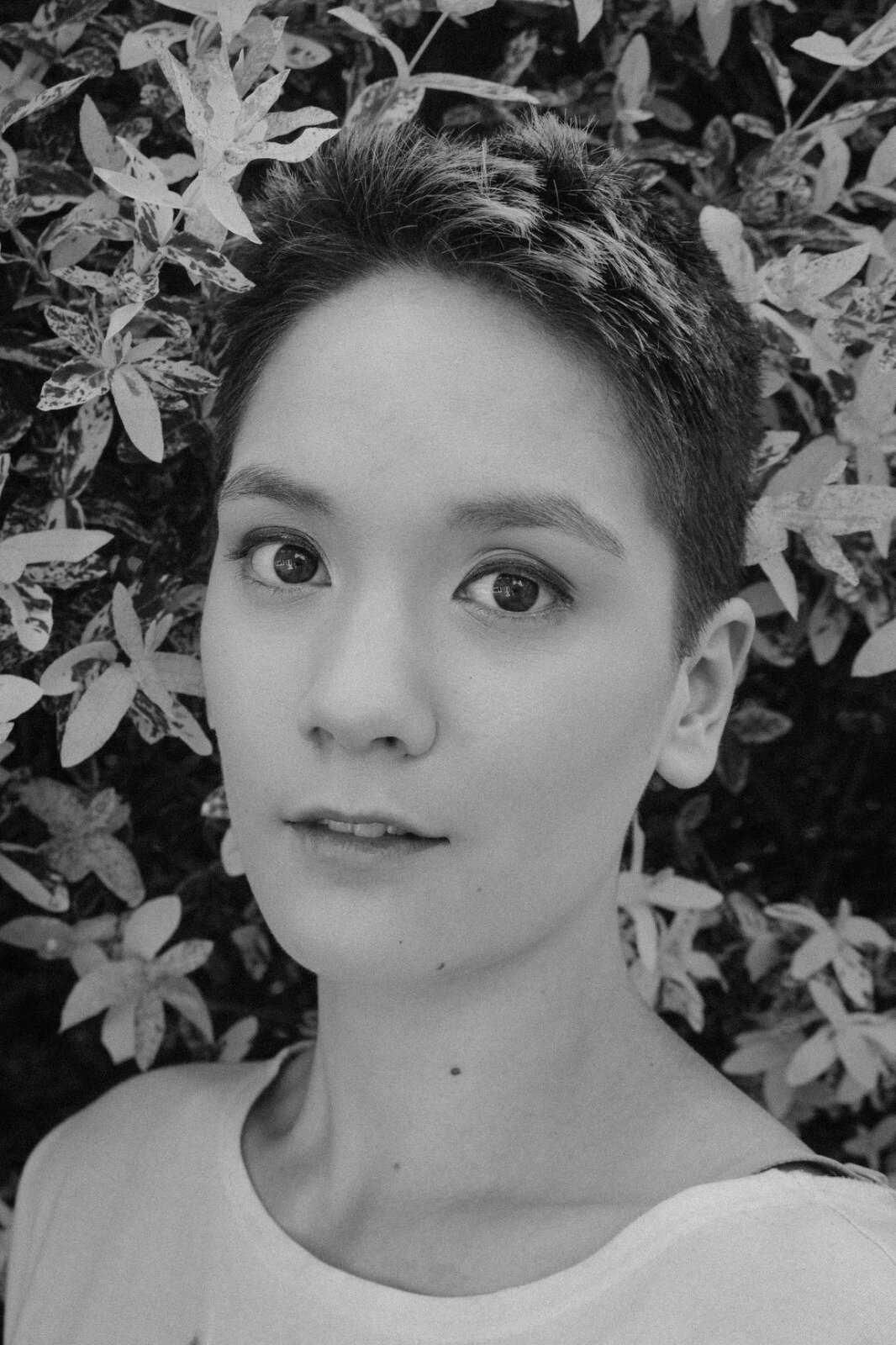
Cat Chong is a poet, transcultural twister child, and a proud queer crip. They're a graduate of the Poetic Practice MA at Royal Holloway and current PhD student at Nanyang Technological University, Singapore where their research focuses on the intersections between gender and medicine to investigate contemporary female experiences of healthcare. Their interests include ecology, feminism, gender, health, contemporary poetics, medical humanities, and disability studies.

Jen Hadfield smaller.jpg

Jen Hadfield is a writer and visual artist based in Shetland. Jen has published three collections, Almanacs (Bloodaxe), Nigh No-Place (Bloodaxe) and Byssus (Picador), which have won prizes including the T.S. Eliot Prize, the Edwin Morgan International Poetry Award, and an Eric Gregory Award. Her fourth collection The Stone Age is due out with Picador in early 2021 and she is currently writing a book of essays about Shetland. Jen has a new 3-pamphlet sequence of writing and painting out soon on Guillemot Press and available for pre-order here.


The making of Tenter, by Susie Campbell and Rose Ferraby

Tenter is our latest poetry publication, written by Susie Campbell and illustrated by Rose Ferraby. And it’s beautiful!

When we first began talking to Susie about the book she expressed the feeling that her poems in one sense were not finished – they required something visual, something of texture, something physical. ‘The visual aspect is very important to me,’ she said. ‘The backdrop of the tapestry, its darns, tears, stains and repairs are the template for this sequence. The poems attempt to find a form in which some of these material aspects of the tapestry are realised.’

This was when we thought of Rose.

Rose Ferraby is an artist and archaeologist from Yorkshire. We have worked with Rose on a number of projects, including on Melanie Challenger’s The Tender Map, for which she won the Michael Marks Award for Illustration. Rose is a thoughtful and generous artist, and she is one of our favourite illustrators to work with.

The feature below has been written by Susie and Rose, with images from Rose’s development of the artwork. They talk about war and memory, monoprinting and illustration, and on one another.

Susie

The writing of Tenter came out of what I perceive to be a crisis in the way that this country makes sense of its conflicts and wars. Whilst the wars of the twentieth century continue to attract parades, poppies and civic war memorials, this does not seem to help us to grapple with the complex international realities we face, nor with the refugee crisis on our doorstep.

My sense of a crisis in our response to war was heightened by spending a year as poet-in-residence for the Oxford Brookes/University of Oxford's 2017-18 Mellon-Sawyer Lecture Series on Post-War Commemoration. This residency enabled me to listen to the experiences of veterans, politicians, historians, artists and survivors of genocide. What emerged was a plurality of voice around any experience of war and conflict. All too often, most of these voices are marginalised or ignored in favour of one privileged narrative. We construct simplified histories by suppressing certain experiences and voices, leaving us unable to make any ethical connection between our national acts of remembrance and our current involvement in international wars.

Tenter was written as an attempt to unpick this kind of reductive thinking about conflict and in particular to problematise any notion of memory or language as a translucent and universal conveyor of experience. This meant I needed to find a form that would allow me to include multiple voices, and to engage more interrogatively with both past and present conflicts. Tenter is threaded together by interweaving not just a number of voices but sometimes a chorus of many voices, with the absences, unknowns and re-makings of history finding ways to appear physically on the page.

Before I started writing, I felt I needed to make a physical visit to a site of a battle. The only battlefield close enough for me to reach at the time was the ancient site of the Battle of Hastings. I kept a diary of my visits, recording the slippery, muddy experience of wandering around a small field on the side of a wooded hill. Many things came up for me during those walks: the resemblance between the south of England and parts of northern France, the turning point in the development of English language and culture represented by the outcome of 1066, and, unexpectedly, an upsurge of personal grief as I remembered bringing my mother on a visit to the site a couple of years before she died.  This field, this centuries-old battle site, became the ground on which I could explore many of the more abstract ideas in my head.

And, of course, this led me to the great embroidery known as the Bayeux Tapestry. As I researched the making of the Tapestry, the common root of the word for textile and text (textere) began to suggest how I might pull some of these complex ideas into the fabric of the poems themselves.

The Tapestry was made in the workshops of female embroiderers, probably in Kent or the South of England. Whilst the job of these workers was restricted to embroidering a given narrative onto the main body of the Tapestry, they had more liberty to improvise in the margins at top and bottom of the fabric. These margins are filled with lively, sometimes shocking, depictions of creatures, scenes and tableaux providing, in places, a subversive commentary on the main action. This was the starting point of ‘Et Aelfgyva’, one of the main pieces in Tenter. The materiality of the Tapestry, its threads, its dyes, its repairs, patches and stains, became important, linking motifs for the whole sequence.

I knew right from the outset that Guillemot would be the perfect publisher for Tenter because of their commitment to making beautiful books in which the poetry and the design work together, creating a richer set of meanings than either on their own. This is exactly what I was looking for. Tenter is named after the 'tenter' frame on which a piece of cloth is stretched for working (using tenter-hooks). The title emphasises the importance of the visual and the tactile, and so I knew I wanted a publisher who was equally committed to realising the material qualities of poetry. Now that I am holding the book in my hand, I realise just how much the vision and the creative input of Guillemot as a publisher have brought to the finished project.

When I first saw the illustrations made by Rose, it was as though we had collaborated on this project right from the beginning. The tactility of her work, and the sense of fabric, materials and 'making' in her illustrations speak back to the poems in a way that opens up new possibilities and meanings. I particularly love the way she finds abstract patterns in the Tapestry - its eyelets, chain mail, patches and stains - and recreates them to amplify a sense of fraying, patching and re-purposing.

Almost simultaneously, Rose and I reached out to each other to put into words the dialogue that had already started between our work, and so I will turn to her to explain how she came to this project.

Rose:

I remember first coming to Susie’s poems for Tenter. I read them late at night before going to bed. Hovering on the surface of them, they were like gatherings of thread cascading away. I went to sleep and my first thought on waking the next morning was of their tantalising depth. I was caught. Over the next few months I spent a lot of time with them, reading between other bits of work or over a cup of tea. Each time, a new element or aspect of the poems began to grow. They reminded me of my archaeological work; slowly digging and getting to know the landscape in new ways, from the feel of the sediment to the narratives it holds.

To read Tenter was to see the construction of a tapestry, the threads weaving together to form a narrative image. Like the great Bayeux Tapestry, these were poems of war, of memory and remembrance. They were poems of loss and losing, but also discovery and growth: rotting and renewal at once.

What I love about illustrating this poetry is that the poems themselves are already so visual. So as an artist trying to create images which enhance and respect the poems – give them space and provide a rhythm for the book – it is really interesting to live with the poems for a while, and see what atmosphere or feeling begins to grow. Very often I get an idea quite early about the particular look the book might take in terms of space, light, speed, colour, mood. Or a particular technique may jump out as being suitable. With Tenter, I felt early on that a print process like collagraph or monoprinting could offer interesting responses to the textures of the poems.

I used monoprinting to experiment with all kinds of materials and ways of printing to explore ideas of textiles but also the rooty depths of landscape. It was a lovely opportunity to gather bits and bobs, from scraps of fabric in charity shops (in themselves a stratigraphic collection of bodies and memories), the stringy bags of tangerines and forgotten strands of lace curtain: everything took on new possibilities as I imagined my way into the poems once more.

The wonderful thing with monoprinting is the versatility that can be achieved with a roller. Sometimes a form is traced into the ink as the roller passes over, and transferred to paper. Or a negative space is formed as it’s rolled over. Or an old tracing combines with the next to create a ghosting in the ink. What’s more, if you excavate into these and look really closely, tiny details can create vast worlds in the imagination.

Particular lines of poem, or the textural quality of images or shapes, led little exploratory experimentations. Words accumulated and found visual form in the ink: ‘tight weave’; ‘a passage through time moth-holed and embroidered by desire’; ‘freckles’ and ‘particles’; a ‘red tongue outlined in gold’.

I made just over one hundred different prints. Like the poems, I looked through them again and again, letting them sit or drift off in the growing imagined form of the book. Some sung out as instant companions to a particular poem, whilst others stirred and roved. I love the stage of combining text and image. New surprises emerge, and – hopefully – both begin to spark in new and lovely ways. A sense of the book breathing begins to form, a rhythm of noise and silence, trickles and rapids. Gradually the moving of images become small tweaks, until, finally, it seems to sit, just right.

One of the reason I love working with Guillemot so much, is the trust that is put in us illustrators; the real joy in experimentation and growth. The books grow from real, rooted collaboration, tended and nurtured by the Guillemot team. Susie didn’t get to see any previews of the illustrations, and only when they were all produced did she get the chance to see and comment upon them. This reflects a great deal of trust on her part – that the illustrations would complement her hard won words. I am always so nervous at this stage – nervous that I’ve understood the feel and subject of the poems, got to their hidden depths and roving meaning. Poems are personal, and to be let into them, to form part of what they are through the images that talk back and forth with them, feels personal too. A strong connection is formed with the poet, even at a distance. It was therefore a huge relief when Susie responded with such warmth and enthusiasm; like meeting an old friend – someone with whom you’ve shared an experience. The finished book is rooted in people and memory, both in the subject and its creation. Certainly now, more than ever, history and humility should be at the forefront of our minds.

Susie:

Looking at Rose's illustrations, and reading her account of her process, it occurs to me that another way of approaching her illustrations is as a kind of reading, a physical, imaginative reading of Tenter that reaches into some of the spaces in the work and fills them with new possibilities and additional meanings.

To read Rose's words that 'to read the poems was to see the construction of a tapestry, the threads weaving together to form a narrative image' is such an affirming response to what I was trying to do in Tenter.  She goes on to say 'they were poems of loss and losing, but also discovery and growth: rotting and renewal at once', teasing out meanings for me that I was barely conscious of when writing the poems. The idea that they are poems of rot and renewal shines a light for me on the way that one poem is succeeded or reframed by another as though an earlier plant has flowered, decayed but seeded the next.

Rose's idea of 'rotting and renewal' also reframes some of what I have thought of as repair. There are places in Tenter where I have patched new voices into old, or where I have pulled much older voices of ballad and traditional song through into stories of later wars. I was emboldened to do this by the repairs, darns and re-stitching that hold together the Bayeux Tapestry. Louise Bourgeois, who worked in her parents' tapestry restoration workshop, was a great believer in the kinship between this kind of repair work and emotional repair. Rose's comment on rot and restoration reminds me that it is the rotting of old fabric, and the decay of memory, that makes room for renewal and for new and imaginative recreations.

Rose's reflections on the process of monoprinting and the way that 'an old tracing combines with the next to create a ghosting in the ink' suggest something of the palimpsest effect I hoped to achieve in some of these poems. Rose's insight here allows me to see my use of linguistic collage and layering of voices as a way of making my peace with the use of the lyric in Tenter. The poem 'Hush' is perhaps the most personal of the poems in Tenter as it struggles to make sense of the place of personal loss within public mourning. It is driven by a lyric impulse but layers up some voices and erases others to create what Rose describes as a 'ghosting in the ink'.

But, perhaps most important of all for me, Rose's illustrations hint at the connection of stitched or fraying fabric with the vulnerability of skin and the human body which brings a deep humanity to the page, and reminds me that compassion, as well as history and humility, should be at the forefront of our minds right now.  

Holding this book in my hands, with its thick, tactile paper and print, its ochre colour hinting at old fabric, parchment, camouflage gear and even the Wipers Times, I am proud to say that it is not just my book, but it is a book made through the collaboration of Guillemot, Rose and myself: it is our book. I hope our readers enjoy it.

To order a copy of Tenter please visit here.
Chloe Bonfield on Illustrating Marine Objects / Some Language

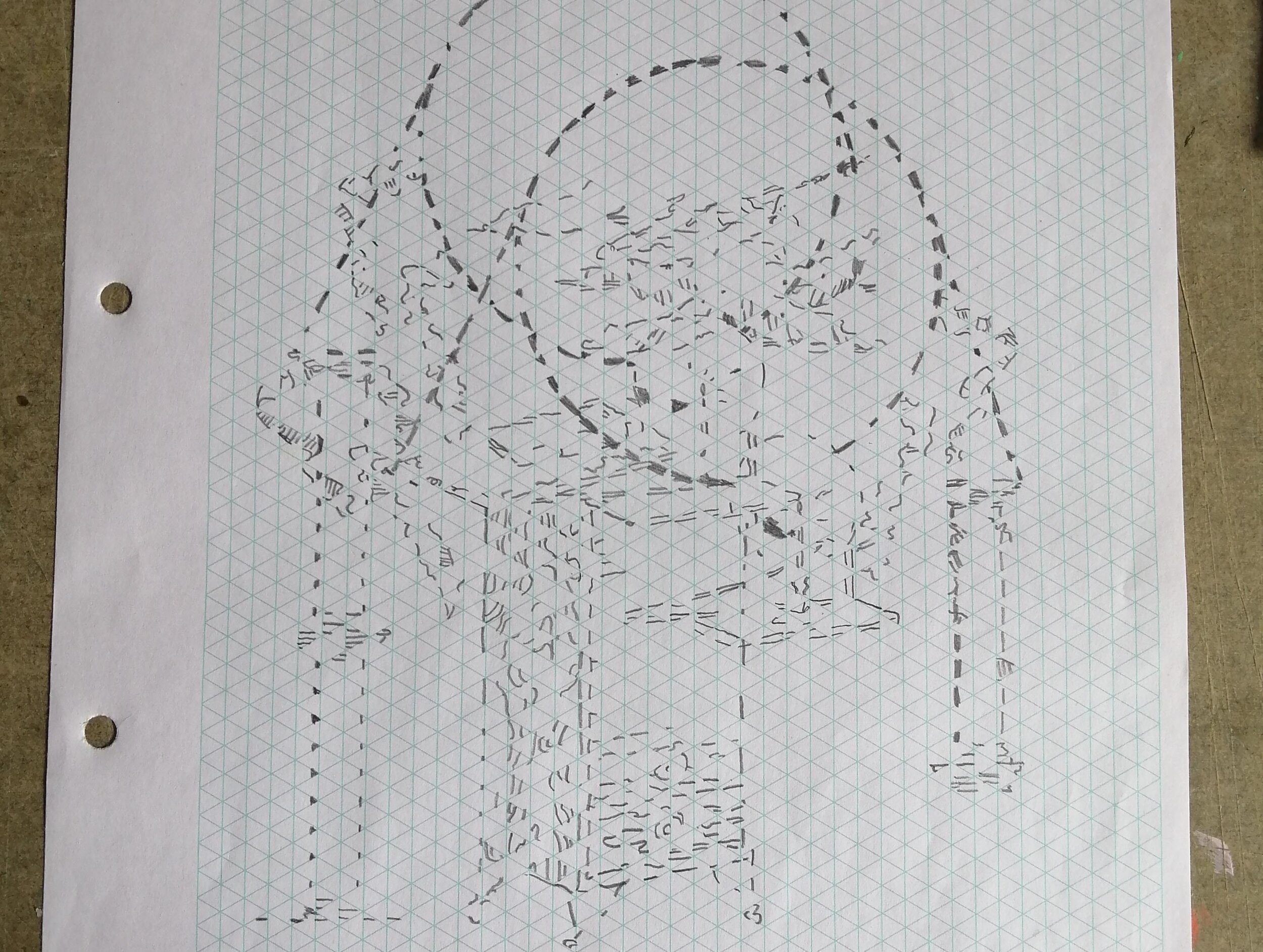
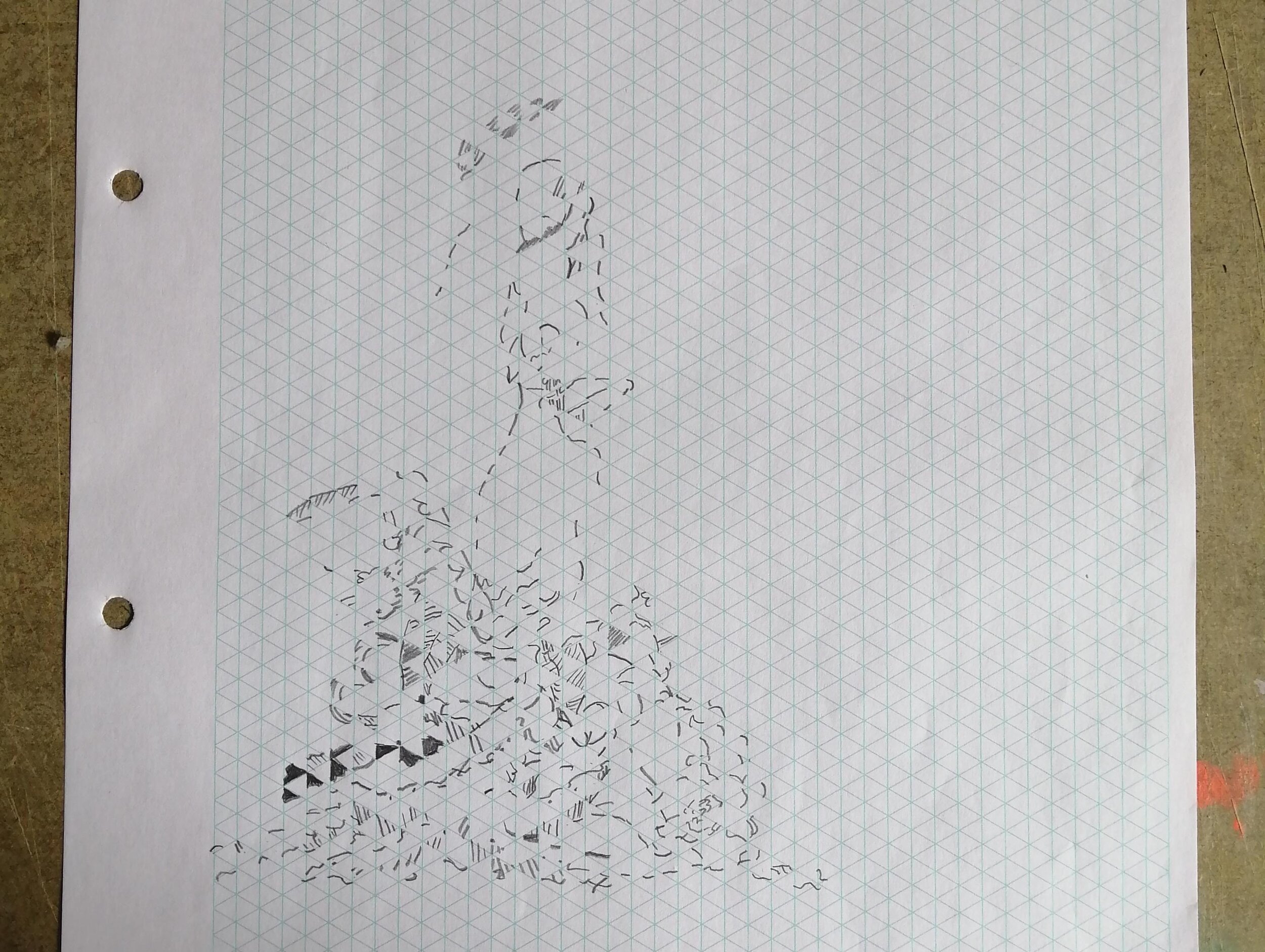
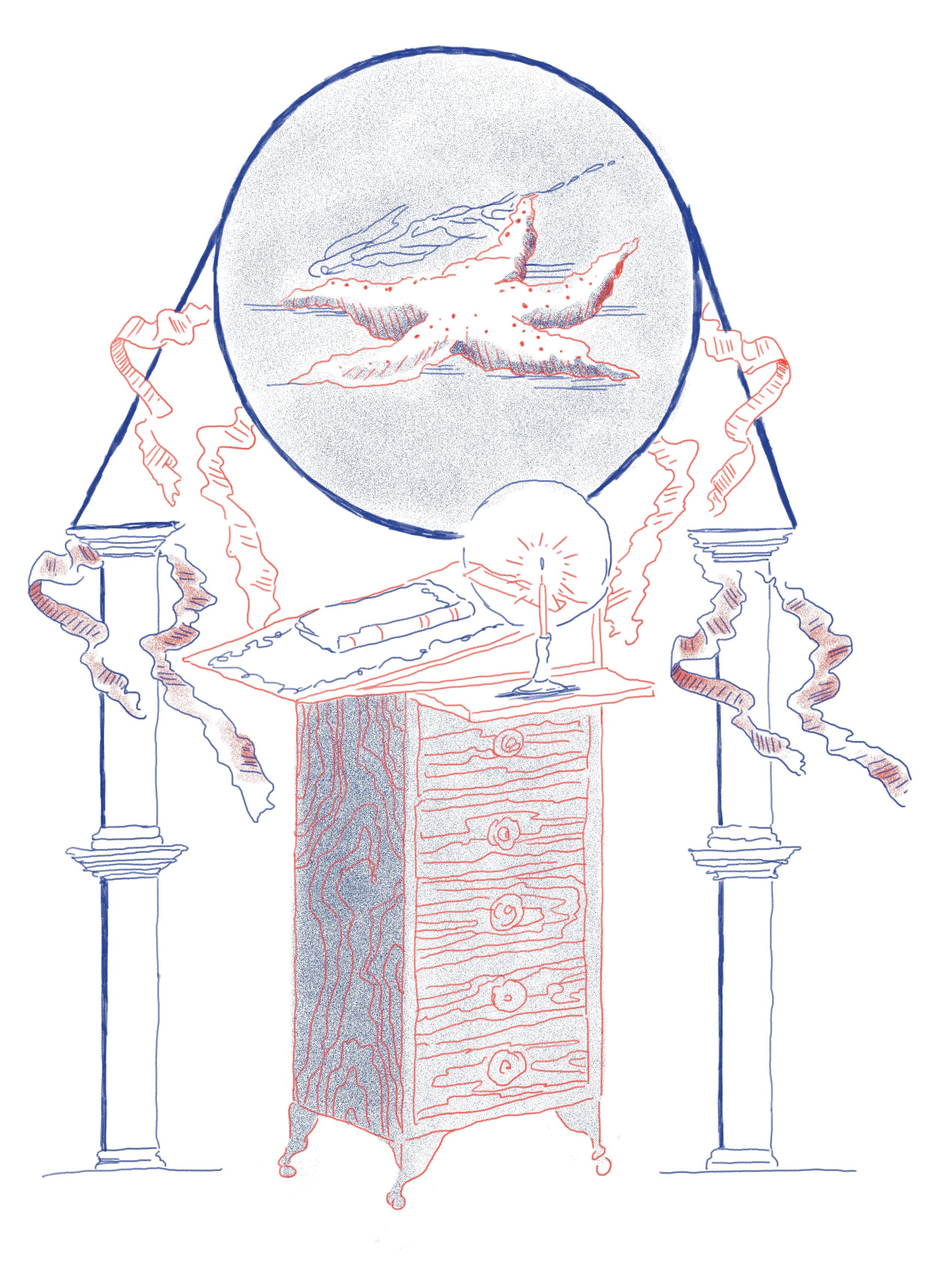
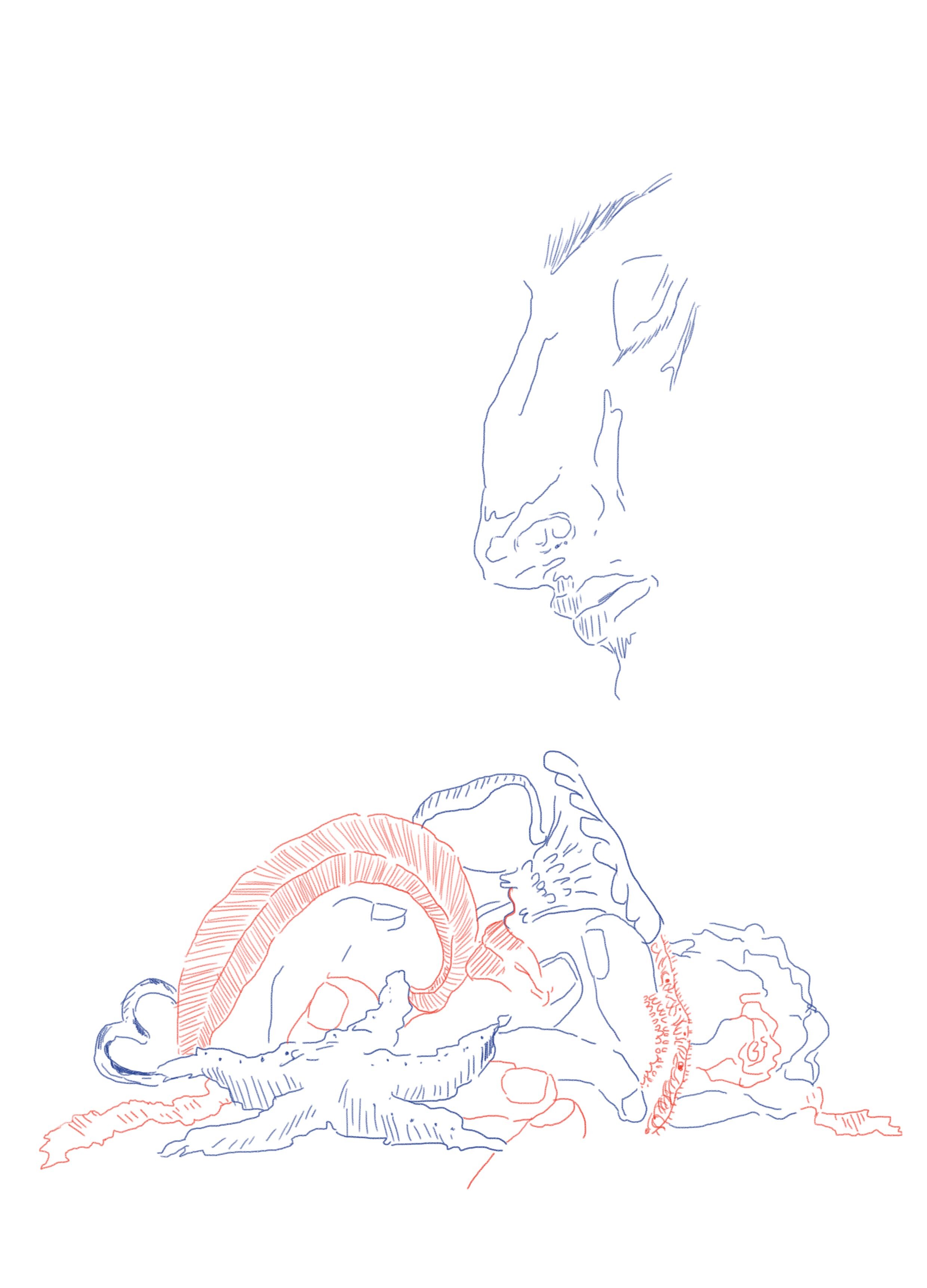
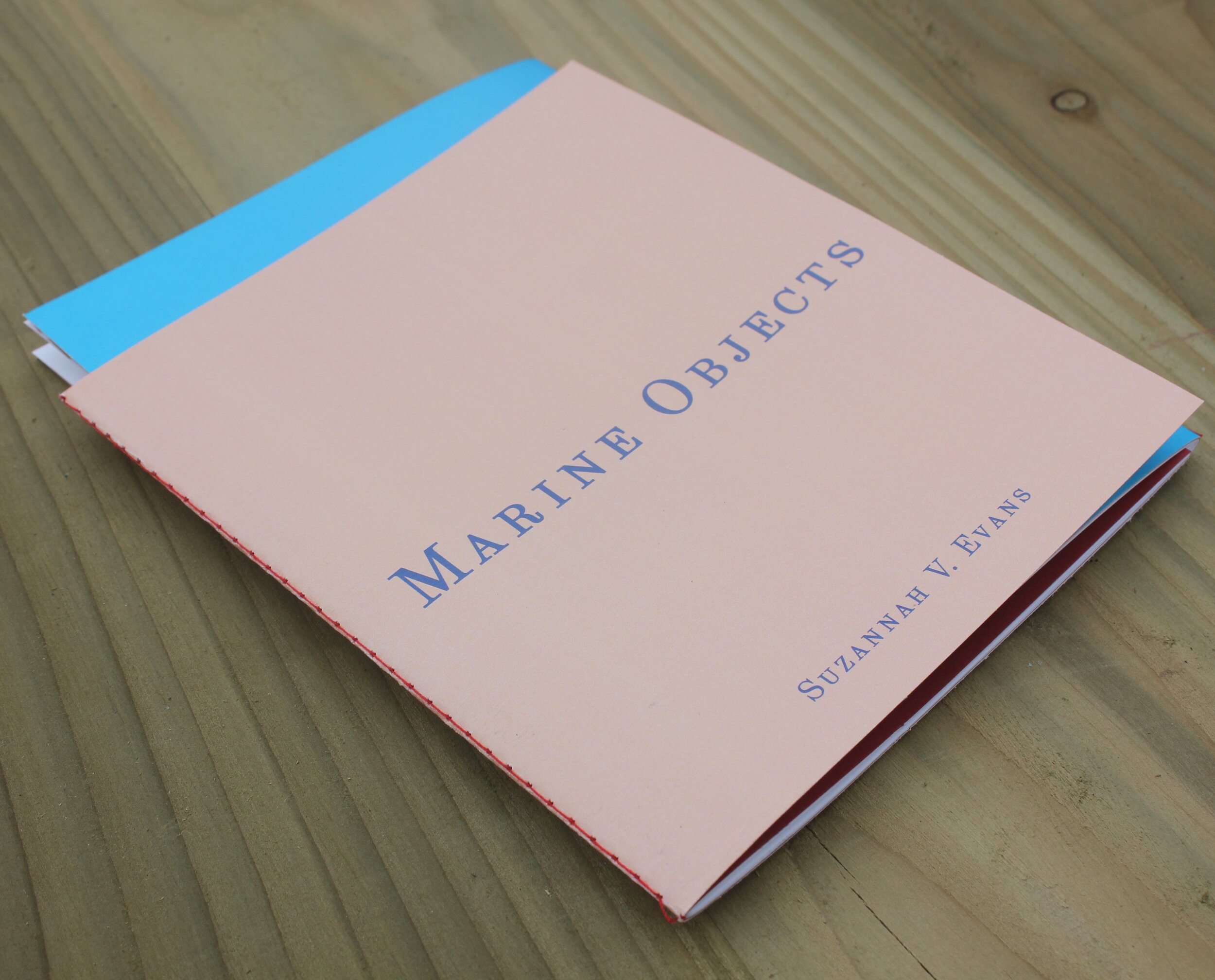
In April 2020 we published Suzannah V Evans’s debut double pamphlet Marine Objects / Some Language, which was illustrated and designed by Chloe Bonfield. We had been looking for the right project to approach Chloe with for some time and Suzannah’s text seemed (and proved) perfect. In this feature, Chloe gives us an insight into her creative practice and process, reflecting on language, emblemata and the relationship between text and image in her work.

On being presented with Suzannah V. Evans’s Marine Objects and Some Language, I immediately engaged with them as a pair, and simultaneously as distinct objects in and of themselves. I was drawn to the colours, to terracotta, and to a feeling that the two pieces were lightly holding each other — light pages with stiff tension.

The first reading evoked impressions from my own lived experiences. Before moving back to the city I had been working in care in Falmouth and somehow saw elements of this in Some Language. In a similar way to how I now feel the distance between here (London) and there (by the coast) I noted the distance between the voice of someone living in a place and experiencing tourists in Some Language. The feeling of watching someone experiencing something that you know so well. It seems to be more about a communication gap of some type, and for me this gap or hole links to desire. In Marine Objects I had the vague notion of ekphrasis but made a decision not to research this further so I could carry out my work.

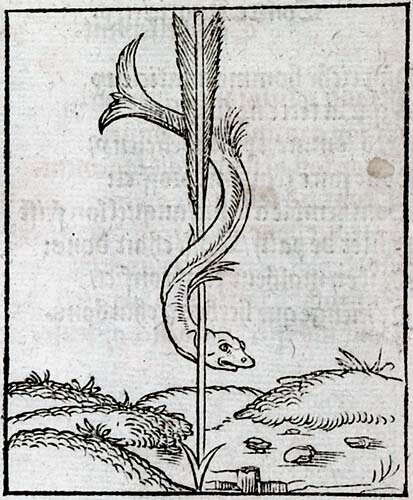
I wanted to approach illustrating the pamphlets using a method that I have recently come to through a mix of research and making, at the centre of which is the Emblemata of Alciato. The Emblemata as a form began in the 1500's and ended somewhere around the Victorian era. John Manning writes about it in his book The Emblem, saying that ‘[t]hey represent not so much a palimpsest, but the growth rings of a poet’s mind...’

I am particularity interested in how the image and text forms of the Emblem, whilst made with some form of artistry, are systematic in their method of production, and how this links to the creation of identity, language and culture. New images are informed by words, and those images live on to describe and transform the identity of an individual or a concept or even a society. Emblems are ‘veiled utterances’ where meaning is generated by dislocation. ‘The familiar, everyday or commonplace’, Manning says, ‘is changed by virtue of being placed in another context: it has become the bearer of unexpected meaning, a metonym for a previously hidden reality’.

‘Maturandum’, (By permission of University of Glasgow Library, Archives & Special Collections.)

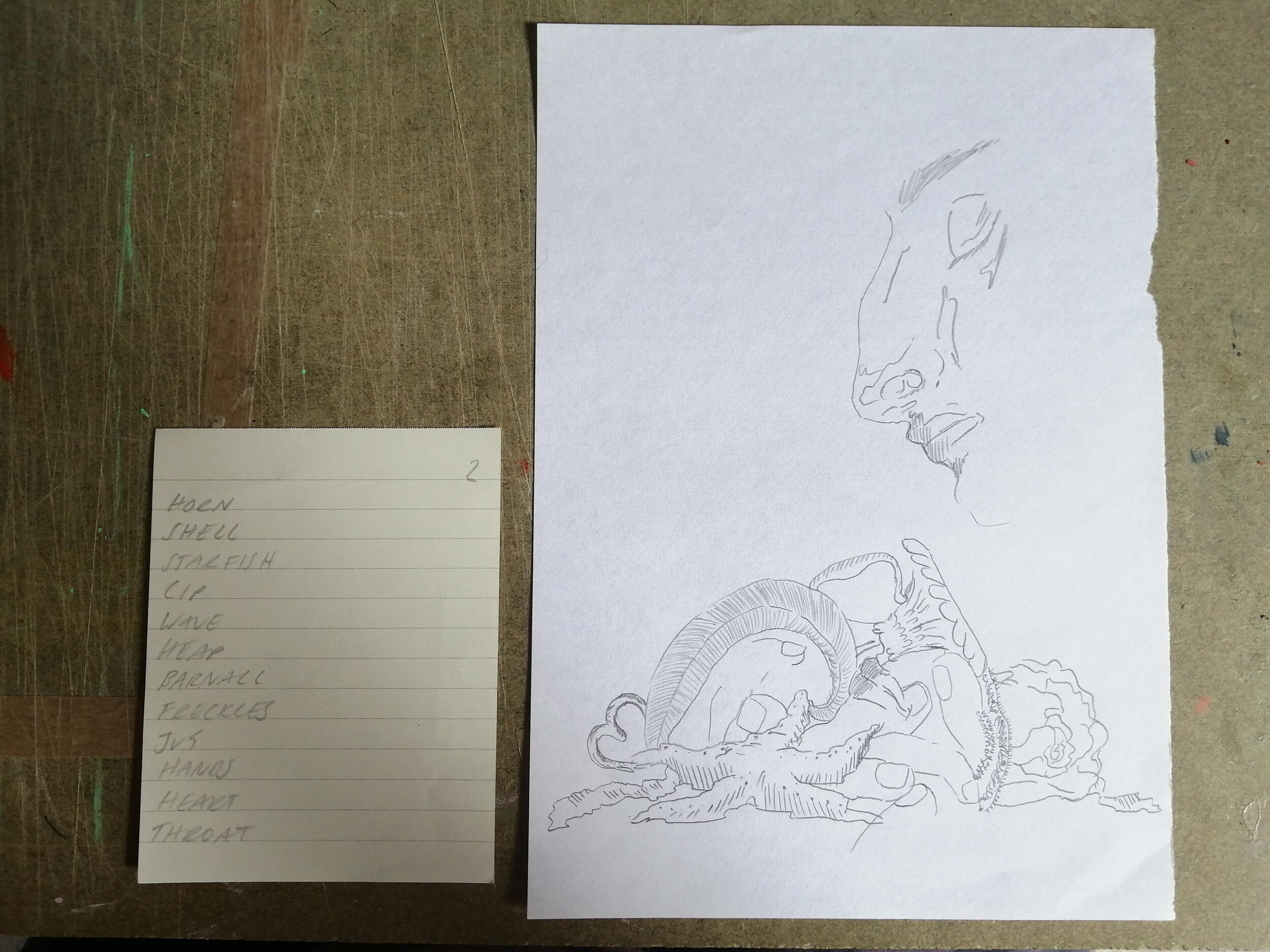
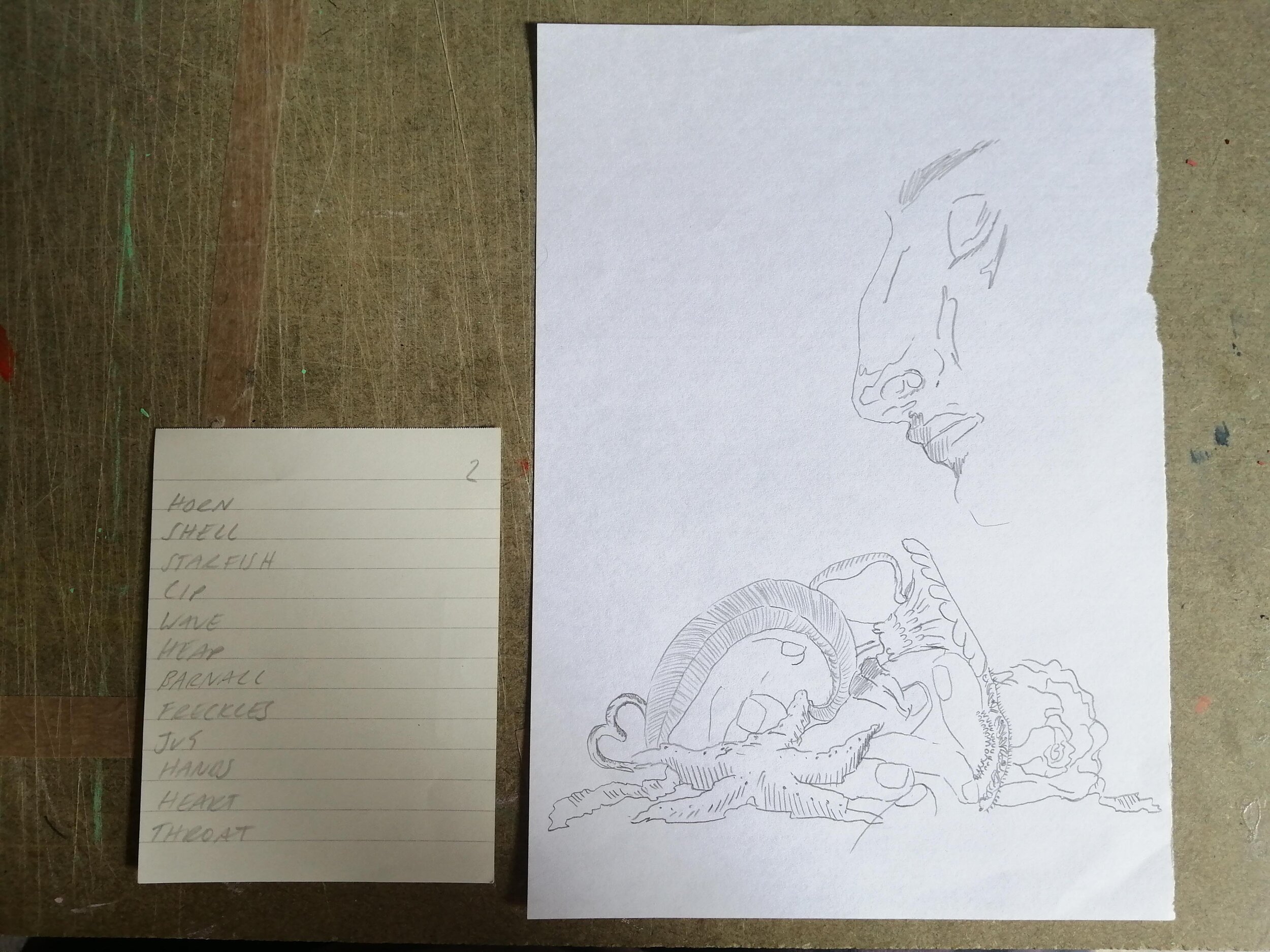
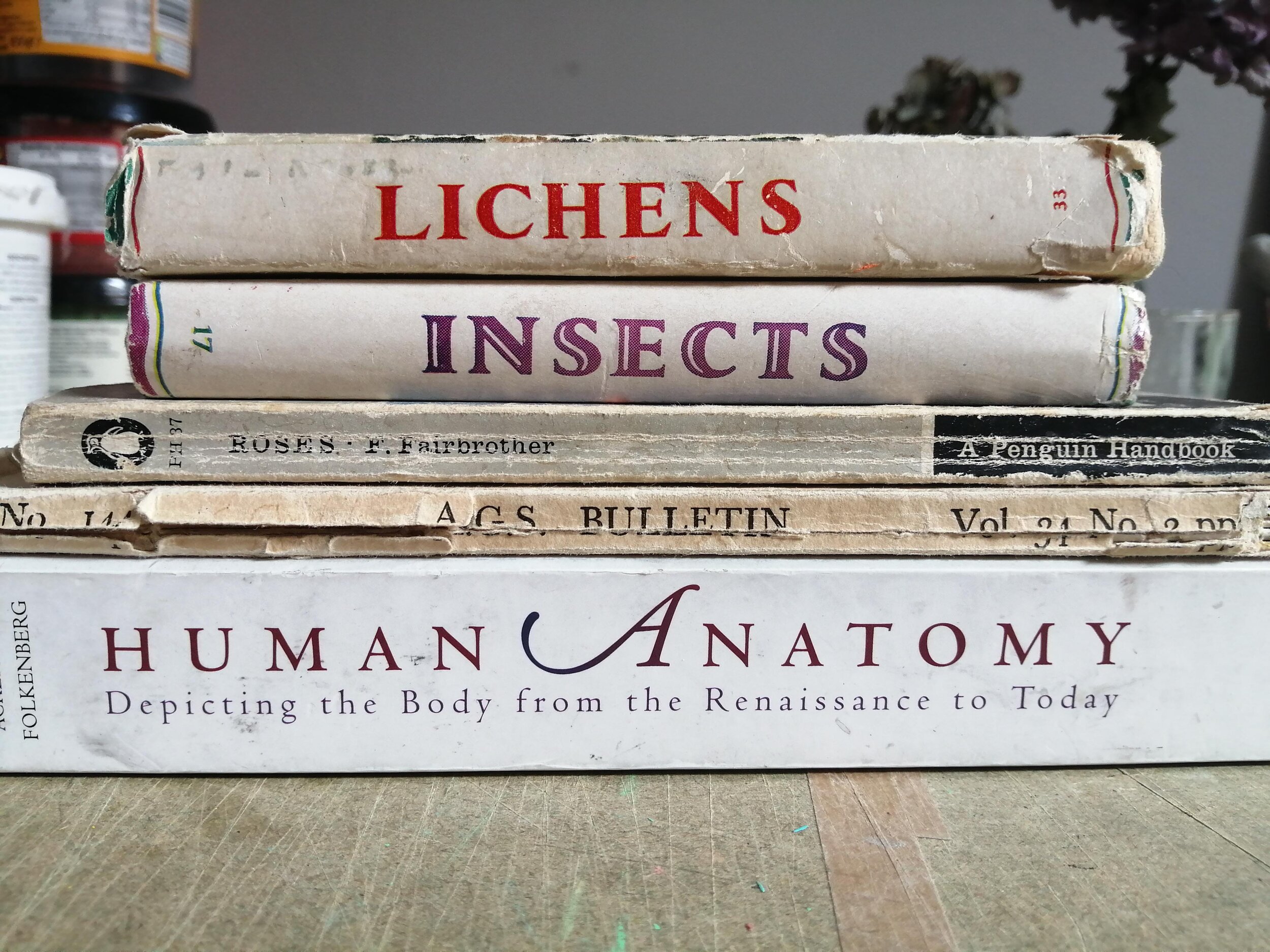
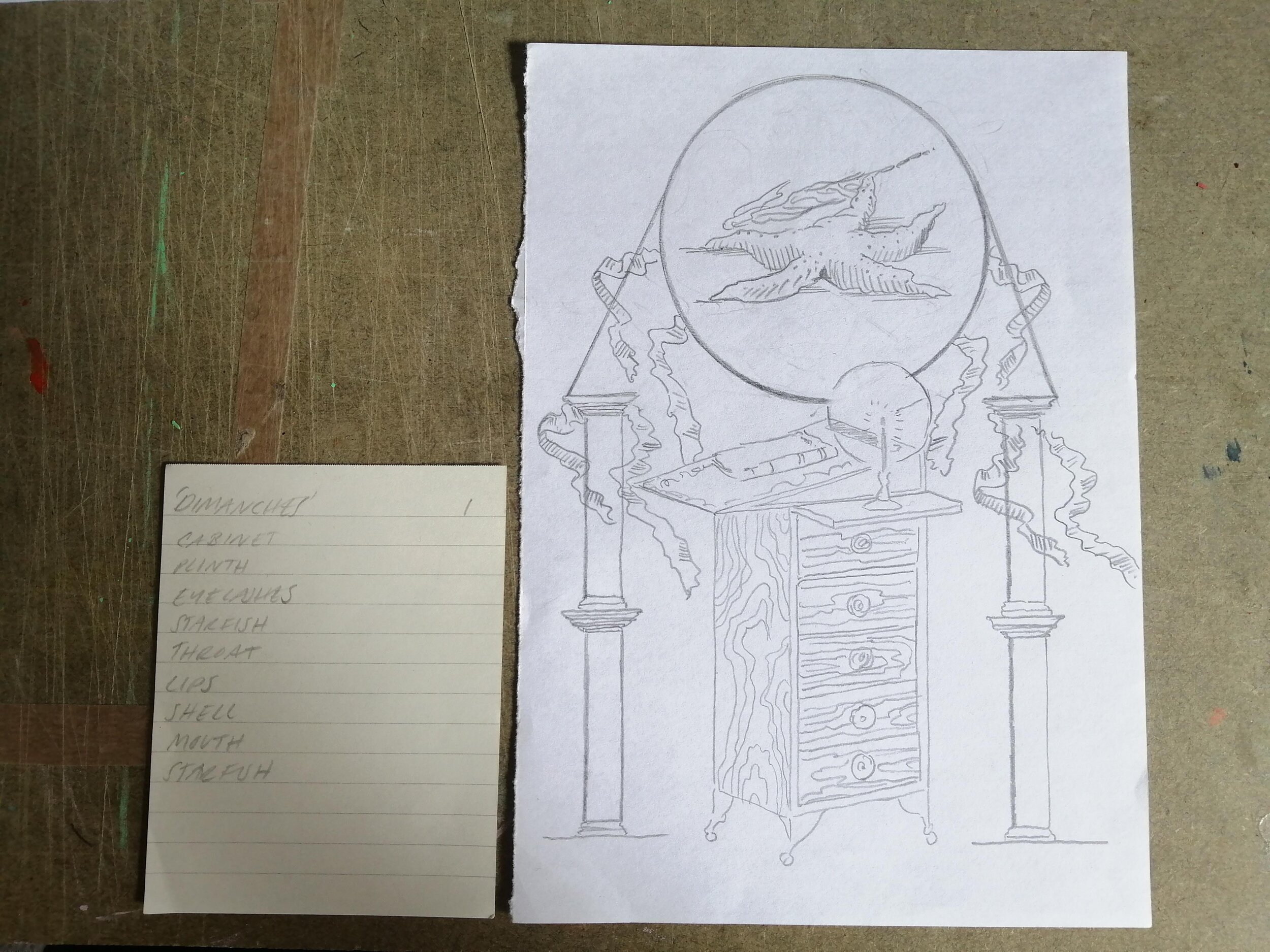
With this in mind I started to make the images for Suzannah's poems. From studying the way the wood block illustrations of the Emblemata were made, I made an inventory of the poems of Marine Objects, selecting words carefully and intuitively. It was a case of looking for those words that highlighted the objectivity of the poems, despite those objects gaining subjectivity within the poem’s structure. The way Suzannah uses language – deftly, with wit and unbelievable creative intelligence — created such an exciting space to work within. After taking inventory of these words I then used my own reference library of books. I like to think about these books from the viewpoint of taxonomy and classification — from Foucault's ideas in The Order of Things, or from Borges' essay 'The Analytical Language of John Wilkins', where the writer points to a list of arbitrary classifications that are shown to be absurd.

Engaging more particularly with the content of Suzannah's writing made me reach to the discourse of Through Vegetal Being, in which Luce Irigaray converses with Michael Marder through philosophical letter writing. Irigaray talks about naming things, about the meaning of this versus the physical embodied reality of experiencing the elements. She writes that ‘[m]ost of the time, we have lost the perception of the difference between meeting living beings and meeting things, be they material or spiritual, that we made’. When we talk about the Sun, do we see its face? This calls to mind the two lines from Suzannah's 'Starfish Balancing at Your Throat':

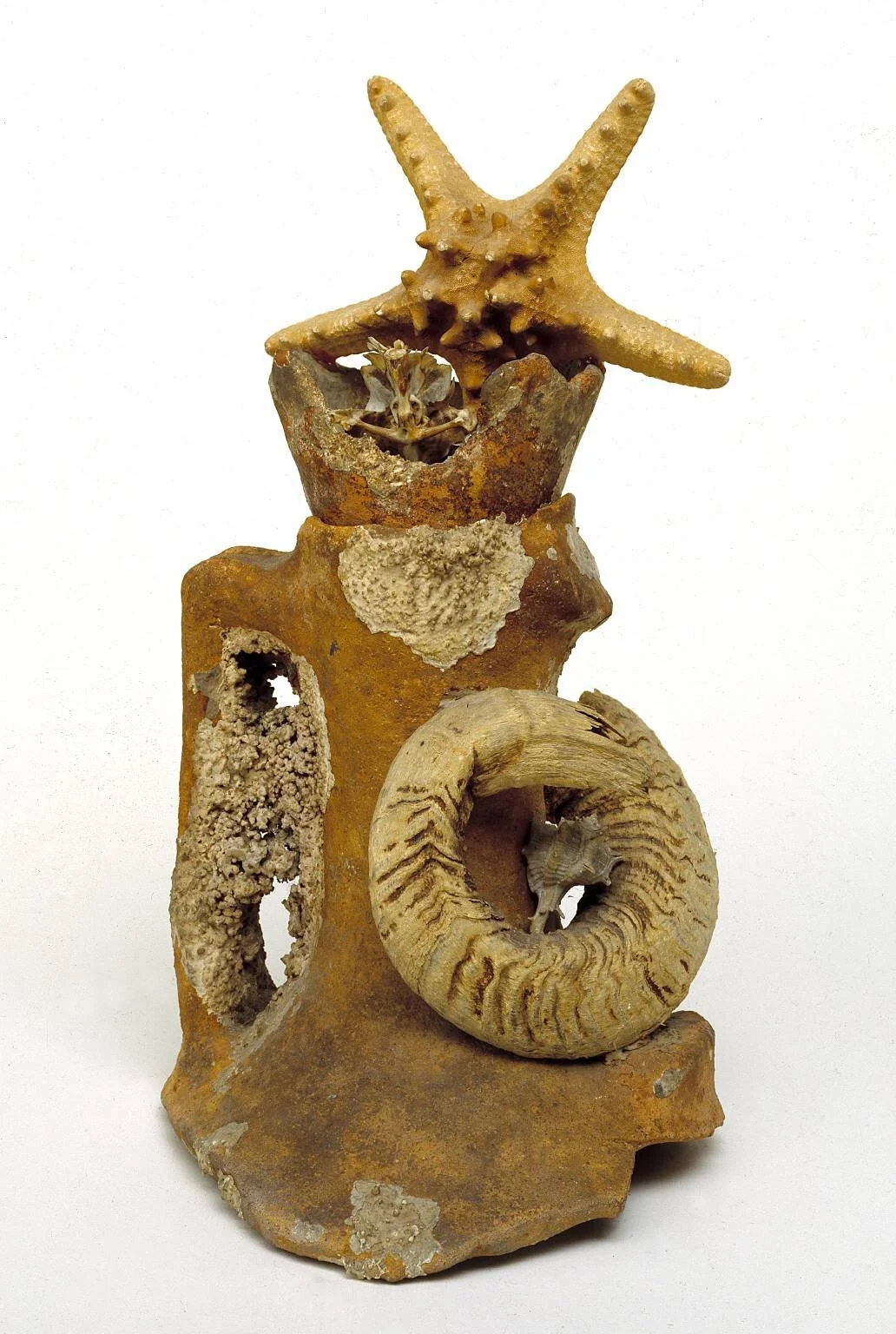
A horn, a shell, a terracotta, a yes, a lip, a burnished,
a thinking, a drowning, a crying, a barnacle, a wave, a heap.

Irigaray later writes how ‘[w]e ought to almost gesture in an inverse way, that is, momentarily consider ourselves objectively in order to decide how to pursue our journey’.

I used reference books to collage, chop and paste, drawing elements for each of the words I had in my inventory. When the wood block carver made their work for the poems of the Emblemata, they would work in a somewhat similar way. Some of them being illiterate, only an impression of the text might be passed on, resulting in a myriad of composites that built image cultures for hundreds of years.

Once I had covered the words in the inventory I used a light box to bring these composite parts together. This is where a balance of intuition and contemplation entered in earnest.

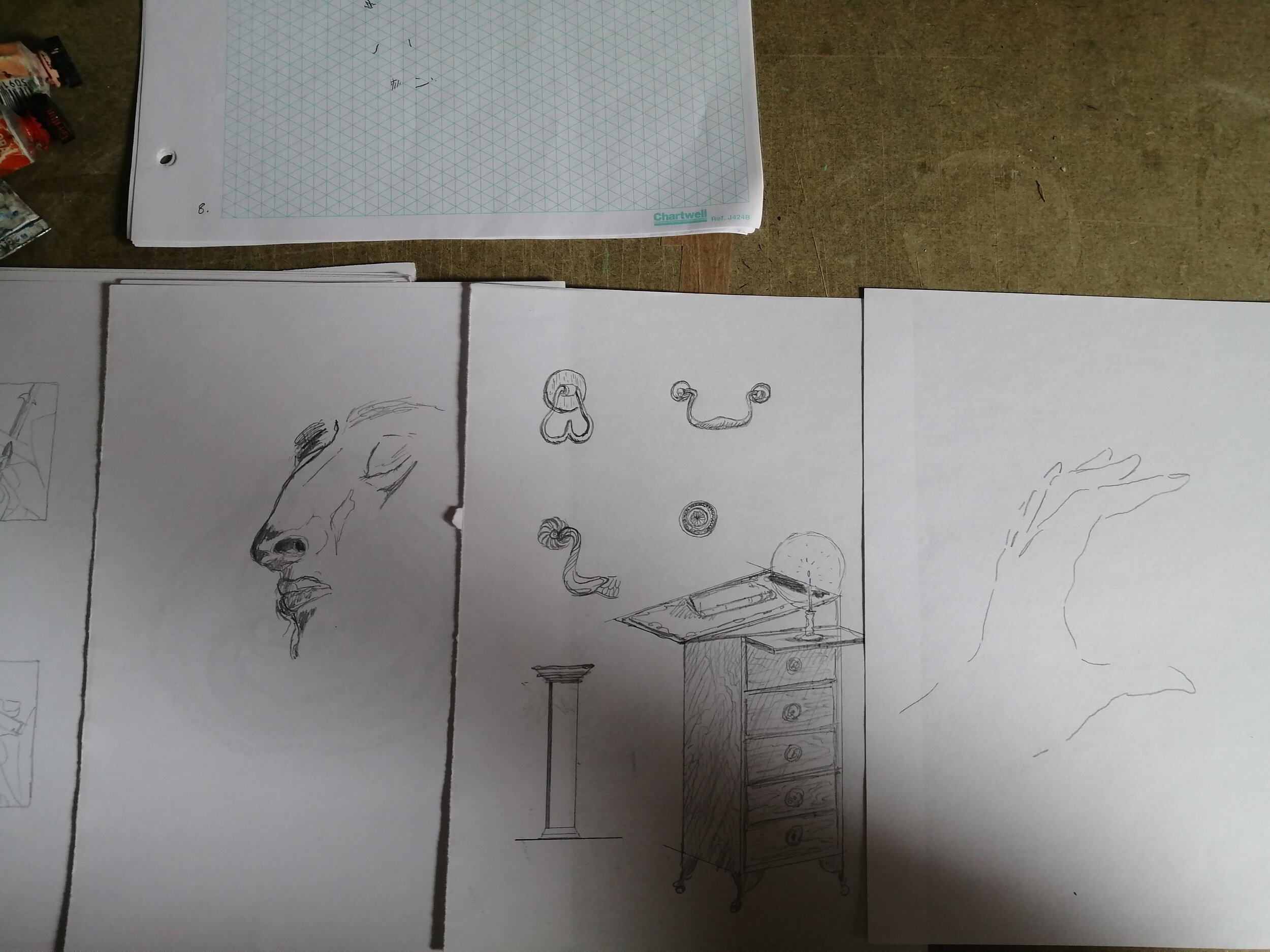
The Emblemata were travellers. The same images were reused, and the same emblems worked their way through volumes and centuries. Whilst thinking of the classification and deconstruction of categories combined with a desire to push the emblematic process further I began to rework illustrations in grid format, the grids either hand drawn or derived from an arbitrary source like a stationary shop. I feel the nature of Some Language lends itself to a fractal and mobile version of words,  and suited itself to this method. Working through the illustrations made for Marine Objects, I re-drew them through grids of graph paper, making turns of ninety and 180 degrees of the drawings, imagining them as travellers to be paired seemingly randomly with Some Language.

I still at this point had not paired the poems with the illustrations. I find a thrill in doing this, in leaving it until I need to make the final layout. At this point in the process I am also thinking about paper, layout and space, as well as a container. That is, how the books will hold or frame the text and image conceptually.

Whilst these thoughts were building, I worked up the pencil drawings digitally. I have several reasons for doing this. Firstly, I have an interest in the digitisation of images and how they can connect with identity, both cultural and personal, and with linguistics. Once digitised how the images translate on the screen, especially when there is also a print version, is fascinating. I work as a print maker, and I use this method to ready my images for print. But further to this there is the physical action of using a tablet to trace over the lines drawn in pencil. Those broader sweeping lines were erased and duplicated, becoming obliterated by one strange thin line made by my hand, attempting to outline the idea that has been made, which in itself is a kind of ekphrasis. The lines become wiggly, odd, distorted further yet still familiar. The colours are simple, easy to replicate in print in concise ways. Then the grids disappear from the images I have drawn, taking away the frame that shows how they are made and what they mean.

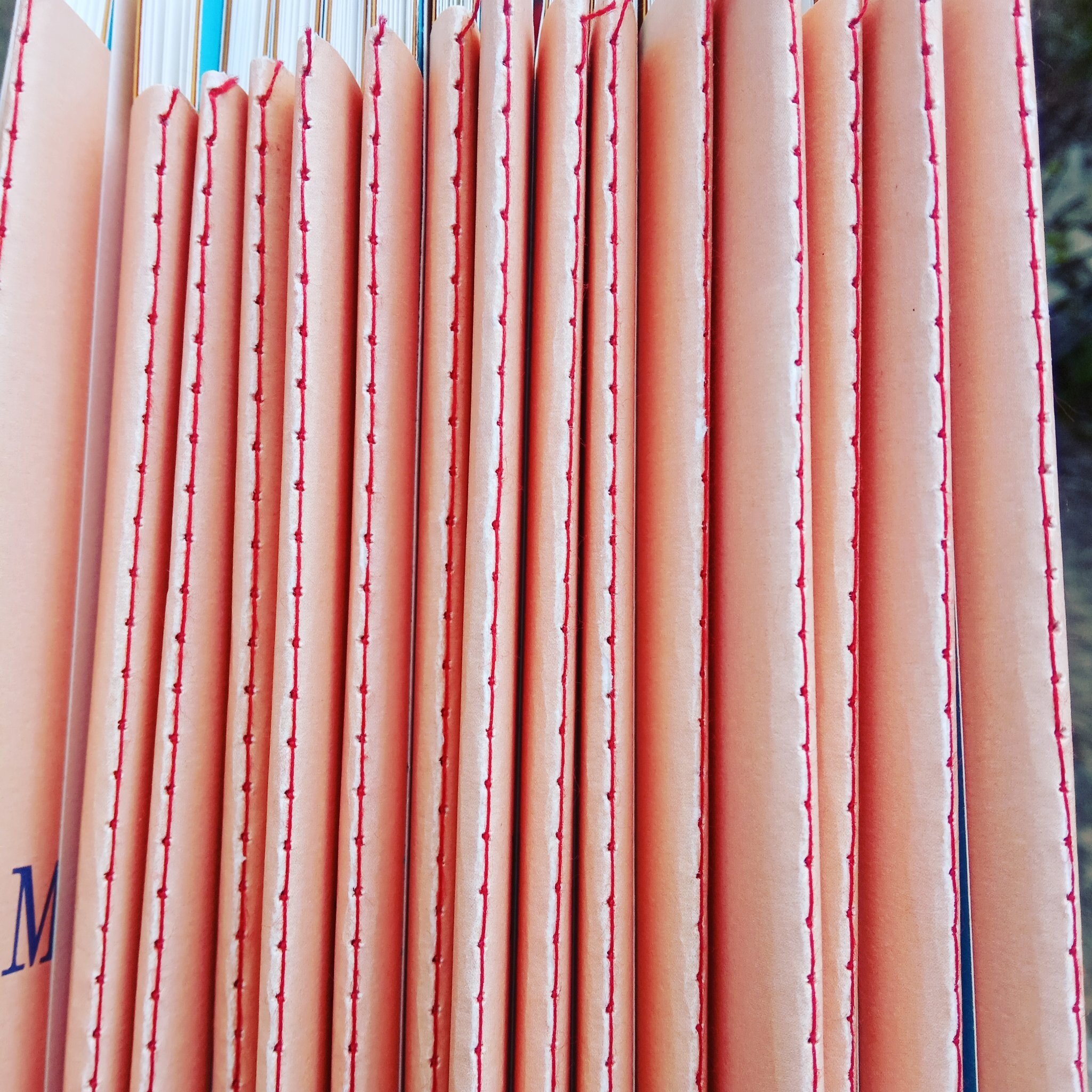
Returning to the container of the pamphlets, which ran alongside this process, the thought of the books holding one another persisted. I started to see the pages interlocking in some way. Working with papers from stationary shops, echoing the grids and graph paper process, I found a pair of exercise books that became a blueprint for the pamphlets’ physical structure. They were both gridded and had singer sewn spines. The covers were stiff and the inner paper stock very thin and delicate. I tried to comb these two together putting their pages one within the other and found they held each other in a tension a bit like a Chinese finger trap. If you pull too hard they won’t let go, but by carefully leafing through the two books they become separated again.

As a layout started to form it felt like this could go a little further, and that the layout needed some space within it. Something to suggest the two were reaching out to one another. Here the idea of fold out pages emerged. The singer sewn spines and stiffer covers would hold them flat, and the end papers would echo the lips, shells and crustaceans, as well as mustard trousers.

Once production had begun I felt ready to look further into the ekphrastic nature of Marine Objects. Reading now inside the back of the book Suzannah writes:

'Marine Objects is based on Eilieen Agar's sculpture ‘Marine Object ‘(1939). In A Look at My Life (London 1988) Agar describes collage as ' a form of inspired correction, a displacement of the banal by the fertile intervention of chance or coincidence'. Words I borrow for the opening of 'Balanced and Barnacled'.

In her introduction to poems in The Modernist Suzannah says that some of the poems of Marine Objects / Some Language were written in response to an exhibition in Cambridge inspired by the writing of Virgina Woolf. I saw a similar show at Tate St Ives. It added a weight to the iterative feel of these poems, their relationships with existing art works and literature, and the potential to continue the iteration through publication.

Discovering the links between Suzannah’s influences and the emblematic process that I followed  was very exciting. It echoed just the kind of poetic contemplation offered by those emblems and by the text and image relationship. I am glad to have followed this playful and systematic form of collage to illustrate these books. I particularly enjoyed the revelation of Agar’s sculptural work that began Marine Objects, which brought me closer to the idea that the bond between the text and image can have a material, or at least, ‘object’ quality. The transition of this into cerebral thought in Some language completed the conversation.

Chloe Bonfield is an illustrator, writer and researcher working in London and the South West. You can visit her website here. And you can buy the double-pamphlet Marine Objects / Some Language here.
References:

Callie Gardner Interviews Francesca Lisette

CG: I’d like to start by talking about sub rosa: The Book of Metaphysics, your recent collection from Boiler House Press. This is a significant collection of work because of the variety of approaches it takes in as well as the ways it folds together questions about art, nature, and spirituality with those of gender, sexuality, and desire. Even to reduce or split the book into these six ‘themes’ seems reductive, because they flow together and because there is a very real metaphysical component behind your understanding of them. How did sub rosa come about, and what do you see as its project?

FL: Thank you for this question!

sub rosa: The Book of Metaphysics has always had this full title, from its very inception. It is written on the title page of the journal it was birthed in, where -many of the poems in the first sequence originated. In March 2011 I was living back with my parents & signing on, having graduated with a Master’s from Sussex, & dwelling in the bleak wasteland of life after graduation in credit-crunched coalition Britain. The protests of the student movement against tuition fees had filled me & an entire generation with a deadly combination of solidarity, fury and awe. I was also in love with a poet and performance artist, and spent most of my dole money on going to see him on the other side of London. It was in this state of tenderness & rage that I found Ariana Reines’ book The Cow for sale in the secret downstairs poetry section of England’s Lane books (which shut down a year later). I chose this book over travel fares for the next week or so, seduced by its weird direct lyric magic unlike anything else I’d encountered. I entered reluctantly at first, but then fell fully in love with it. I now wanted to challenge myself to write a book: a cohesive whole which would fall together. I was determined that the book must have a tripartite structure, & I think that both that idea & the title sprang fully formed from the extraordinary painting on the cover of the journal in which it began: 

Our Lady of the Barren Tree, Petrus Christus, c.1450

Our Lady of the Barren Tree, Petrus Christus, c.1450

The concentric eggs of being represented through: tree/ elder/ language matrix; mother (principle of gender and conception); child/ symbol/ idea – fed directly into the writing of Becoming. At some point I thought I’d write in detail about the depictions of women in religious paintings in the National Gallery, about how we couldn’t have anything other than a sexist culture while this remained the venerated canon which daily processions of schoolchildren toured around. Eventually this morphed into its current incarnation as a sequence on motherhood, pain & gender, which itself was more directly inspired by the tense-bending, evanescent tongue I found in Clarice Lispector’s Agua Viva.

The third part of sub rosa was always intended to be a dance/performance piece. Yet it took a very different form from what I originally imagined. I thought very carefully about the progress of the sequences: from highly individualised initiation through sorrow, culminating in ‘Deceit & Habitat’, where the apex of miserable consumerist/ sexual substitution is reached; to an engagement with inheritance and identification (or the lack of it) in Becoming, and then, to a movement out into community. A gradual process of erosion and de-individuation. Originally I had envisioned this final part as a collective dance piece, but it became a personal ritual of transfiguration, a way to mark how my understandings and the project had changed, and to let old forms slip away. Which was always the intention of sub rosa: to find my personal writing voice, my own real concerns.

CG: It's been six years between your last full-length collection Teens and sub rosa. Although there are commonalities in the style, the extraordinary facility with language, and the sense of the possible, sub rosa seems a more sober working with a stronger sense of internal consistency – this is not a criticism of Teens but there seems to be a difference in the poets that informs the two books, although crucially both texts address sensuality and the body (reading ‘Three Strikes’ against ‘The Moon’s Move’, for instance). How do you see the relationship between these books, and how did you move from one to the other?

FL: Yes! There is a distinct difference between these two books. When the publishers of Teens approached me, they were keen to bring together everything I had done. At this point I was already writing sub rosa, and I didn’t want to mix the two projects. I was very clear that everything I was writing that was part of this project was of a distinctly different style.

As I’ve hinted already, I felt that Teens encapsulated a very specific part of my life as a poet. It isn’t an accident that sub rosa begins with a poem written to a poet on the other side of the world with whom I had shared some of that specific, secret life, the intense enthusiastic kinship which germinated the communal poetics and orientation in the world for that small & still close generation. I am more or less entreating him to answer for the world of philosophical, imaginative grandeur we had left behind, which hangs over the frightening banality of life outside it, like a vaporous gateway it seemed impossible to re-enter.

More than a difference in poetic influence, I was gobbling up every form of avant-garde poetry I could get my hands on when I was writing Teens, and it all fused together to create its anti-stylistic, trying-on-everything-for-a-second-but-still-specific style. sub rosa is different because I started to know what I really valued in writing, and I came to learn that I value process and concept more than style alone.

Much of my process with sub rosa was about learning to trust the work. Quite often with certain poems in Teens I lacked the confidence to bring the poems to a point of personal satisfaction. With sub rosa, I only kept something in if I was 100% certain of its veracity, its accomplishment: at times that meant trusting the work’s capacity to speak beyond my understanding, for we shared the same horizons if not the same acuity of vision. (Poetry knows more than its makers do; perhaps there’s little joy in writing it without that precondition.) What could sound like control in this context is really surrender: if a poem couldn’t be brought to fruition I assumed that it didn’t want to be born for eyes other than mine, & let it go.

CG: In many of the poems of sub rosa, it seems that you give that trust to the poem as a way to reflect on ideas for which the language of direct statement is not always sufficient, and one of those is gender. ‘Becoming’ and ‘Transubstantiation’ are the ones I find most affecting in this way, and they feature the interrogation of the category of ‘woman’ in particular – ‘not the true feminine, but the suppression of self that I experience’. How do your poems think about gender, and are there other poets who come into that process for you?

FL: I have, quite literally, contemplated this question for weeks. So thank you for such a bold and complicated question! I guess I should first obviously state that my poetry is inseparable from my thinking process as a feminist and non-binary person. Nonetheless, my poetry was initially nurtured in an environment which was predominantly heterosexual and overwhelmingly white and cis male. I am thrilled to see the way UK poetry has shifted over the last decade, towards a more diverse range of voices and traditions – it is a genuine source of joy and relief. This includes your work with Zarf, Gloria Dawson, Dom Hale, Nisha Ramayya, Caspar Heinemann, Azad Sharma & Kashif Sharma-Patel of The 87 Press, Pratyusha, Momtaza Mehri, and so many more. It creates space for so much and so many, and I’m really heartened by it.

In certain poems from Teens and the first and second sections of sub rosa, there are clear critiques of misogyny, marriage, the disposability of women as love objects and screens for projection of unhealed patriarchal wounds. ‘Casebook’, from Teens, represents the subject speaking back, and this was the first time I felt I’d broken through as a poet to what I really wanted to say. I looked at many photographs of the Surrealist women and made collages and drawings alongside the poetry to better understand the fragmentation and depersonalization experienced by many of the long-suffering Surrealist women artists and muses, such as Unica Zurn, Lee Miller and Leonora Carrington. Throughout ‘Becoming’ I examined archetypes of femininity as the idea of ‘non-binary’ began to properly take hold in the broader conversation about gender, and ‘Transubstantiation’ attempts to capture my new understanding of my own genderfluidity. Then the third section aims to liberate the self from the prison of false projections, dissolving and reconstructing them via the compositional stuff of life itself.

My newer work seems more ethereal and strange and genderless than it has ever been before. Much of this writing seems to emanate from a chorus of voices, moving between individual bodily experiences and group mind.

Women writers and artists have always been my first love, and primary inspiration. Important poets to me on the subject of gender include: Mina Loy, John Wieners, the always-extraordinary Marianne Morris, Tatiana Luboviski-Acosta, Emji Spero, Caspar Heinemann, j/j hastain, Nat Raha, Samantha Walton, CA Conrad, TC Tolbert, Ariana of course, John Wilkinson, Bhanu Kapil, Celia Dropkin, Marosa di Giorgio, Amy Berkowitz, Sara Larsen, ANNE BOYER… oh I could go on and on…

CG: Your poem ‘A Dream of the Cyborg as a Metaphor for the Historical Body Called Language’ appeared in the ‘Trans/queer’ issue of Cordite. This bodily/dream poem echoes the treatment of these concerns in  sub rosa. How did that poem come about, and what role does the ‘dream’ play in your poetics?

FL: ‘A Dream of the Cyborg…’ was written when I was in daily rehearsals for Alexandra Pirici’s performance piece, AGGREGATE. The piece features approximately 90 performers, all of whom are enacting a repertoire of gestures echoing images and sounds from art history, the animal kingdom and popular music. We were rehearsing and performing every day for two or three weeks. This poem sprang fully-formed out of the physical experience of inhabiting these cultural spectres, holographic cyborgian echoes from a future we can only guess at. Partway through the run I shaved my head for the first time & felt like a gender-ambiguous alien cat witch.

I have written from & through the dream state. I wrote some poems which are actually just straight transcriptions of extremely odd dreams I had. I keep a dream diary and also have precognitive dreams which frequently prove alarmingly correct. This leads me to understand dreams as a way for our intuition to speak when we are not listening, both to warn and enchant us. I also often write from a (conscious) altered state, which I reach through meditation, trance, movement, communion.

I’d say that poetry itself is a kind of dream state: a harmonic pattern encoding mystery which makes no logical ‘sense’ but feels utterly real, true, important. In that sense I would say that ‘the dream’ – of a different life, a world liberated from the kyriarchy in which the earth, the sacred and the interconnectedness of all beings are foundational ideas – is central to my poetics. For me poetry is a way to enter that world, whilst inhabiting this one, and in that regard it truly is a practice, which tests language’s powers of mediation, code-switching and capacity to hold contrary densities.

On a related body/ dream note, I am particularly interested in how movement has the capacity to affect what and how we write. Three minutes of dancing or breathing can completely change how you feel, get you into your body, and open up areas of consciousness that are otherwise inaccessible. It is really about having more presence & breaking the cognitive grip over your linguistic faculty. Much of the work in sub rosa – ‘Becoming’ and all of ‘Ecstasy (Dispersal)’ – are written directly from this state of sustained physical engagement.

In an ableist, capitalist world, in which some bodies suffer more than others and emotional trauma is passed down as illness through generation after generation, the body remains a battleground. When the world that is summoned in poetry (& the arts more widely) is brought into our physical experience: is that magic? I believe that for everyone, and especially for those of us in various positions of oppression, these moments of presence or transmission which art facilitates give us the opportunity to change our lives and shape our resistance more effectively. That is why for me, everything I do is both a practice in its own right, and part of a larger system aimed at healing and empowerment.

CG: In a climate where many poets are attached to academic institutions in various capacities, you’re walking a rather different path. What advantages and challenges do you think this presents for a writer? Do you see universities’ involvement in literary cultures as benign, pernicious, or just something you’re not interested in?

FL: I would love to pursue a terminal degree. Due to various circumstances, it hasn’t happened yet, but it’s still my intention to do further study. My non-institutional existence is not as deliberate as it may seem!

There’s a great deal to say on this topic, so I will restrict myself to two points. Firstly, my decade outside of academia has been instrumental in helping me to understand myself primarily as an artist rather than as an intellectual or critic. I often feel that experimental poetry has more in common with the visual arts and music, rather than fiction, and it might well benefit from being taught alongside those instead. I see poetry as occupying a separate genre from mainstream fiction, since they involve vastly different cognitive processes for reader & writer – whereas the ‘novels’ of Kathy Acker, Ann Quin and Beckett have so much to offer contemporary poets and artists.

Secondly, I understand that given this often-restrictive labelling of poetry as ‘imaginative literature’ rather than as sonic, physical, or visual experience, it may struggle to survive outside of academia as the considerably less popular cousin of narrative storytelling. What I’ve witnessed first-hand as a performer and writer, however, strongly challenges that conception. People are fascinated by the strange magic of poetry whenever they encounter it, and are far more open to experimental work than mainstream culture would have us believe. Small press & experimental arts have always thrived in non-institutional settings and DIY scenes.

I also believe that working in academia, being prompted to engage with literary texts in depth and open the invitations of that work to others can really fuel one’s writing. From a funding perspective, I wish there was more financial support for experimental and interdisciplinary poets who aren’t attached to academic institutions, simply because it is very difficult to make work outside of them.

I guess that universities’ involvement in experimental poetry both fosters its continuation, and unnecessarily inhibits its development and ability to reach across social divides. But really the problem is structural, and thus political: rather than blaming universities, we should ask what the hell has happened to public support for boundary-pushing arts and culture, and why it has disappeared. (Those who wonder what I’m talking about should investigate Derek Jarman and Charles Atlas’ work with Channel 4 in the ‘80s, for starters.)

CG: As well as being a poet, you also work as an astrologer. How does your poetic practice tie into your work with Glitter Oracle? Does the process of doing those readings involve any of the same skills and energies as writing poetry, and/or performing?

FL: Definitely, yes! The process of reading a birth chart or a spread of cards is very similar to writing an essay on a work of literature or art you adore – that is, you are showing understanding through extensive engagement and debate. Intuition and counselling skills also play a major part, but essentially with astrology you are decoding a snapshot of a moment in time. (Maybe this also helps to understand why tea-leaves and even entrails have been traditionally consulted as divinatory portals: future & past meet in the unconscious traces of the present). Most fascinating is watching people slowly realise that planets and transits aren’t external energies, and therefore are not something to be feared.

Something I value in both poetry and divination is precision. Both offer uniquely specific vocabularies for conscious experience. As we know, poems are spells which can enable their writers and readers to redistribute and reclaim power in both subtle and profound ways. Mythology, mysticism & astrological terminology permeate my writing from the beginning, because I discovered astrology and tarot at about the same time I started writing the work that would be published in Teens. I’ve been working with crystals and spells and the natural world since early adolescence. I think people often assume I’ve gotten into esoterica in recent years, but the atmosphere’s just been more conducive to coming out of the spiritual closet.

Lastly I would say that poetry, astrology and tarot are all both creative and receptive arts. Many artists have had the experience of ‘channelling’ a piece of work, which arrives more or less fully-formed, although for most this is the exception rather than the rule. I think poets are spirit-workers, whether they are conscious of it or not. We work to attain finely-tuned linguistic antennae, combining the transmissions received with personal intellect, patterning and musicality in order to express something beyond regular comprehension. In that regard, it’s always a collaboration: we do the work and then trust it to transcend us. Art must find its audience, just as intuitive readings work best as conversations. Personally I love making writing and art without knowing where it’s going, art which teaches me how to let go and dance with the uncertainty and opportunity it offers, which is basically a metonym for living with awe.

FL.jpg

FRANCESCA LISETTE is the author of Teens (Mountain, 2012) & sub rosa: The Book of Metaphysics (Boiler House, 2018). Recent work can be found in Chicago Review, MOTE and the anthology SPELLS: 21st Century Occult Poetry. They are teaching a class on astrology, embodiment and writing for creative practitioners – learn more & sign up here.
CG.jpg

.CALLIE GARDNER is a poet and editor from Glasgow. Their book naturally it is not. was published last year by The 87 Press and they edit Zarf poetry magazine and its associated pamphlet press Zarf Editions, which has most recently published work by Pratyusha and Alison Rumfitt.

Conversations - Bodmin Moor Poetry Festival 2019

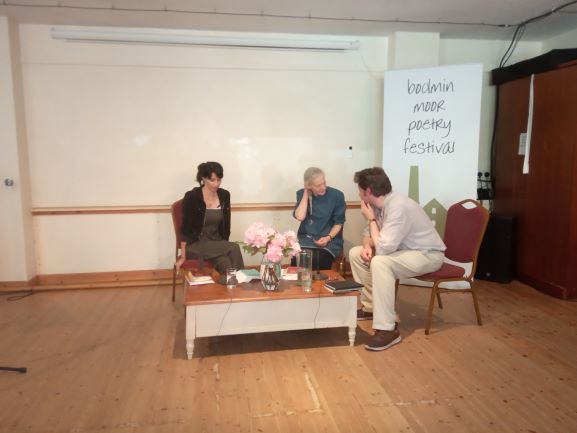
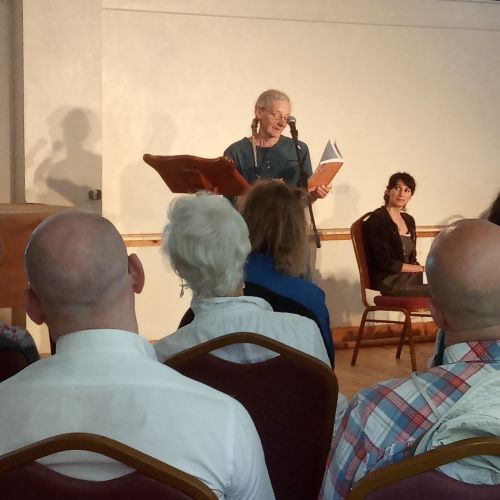
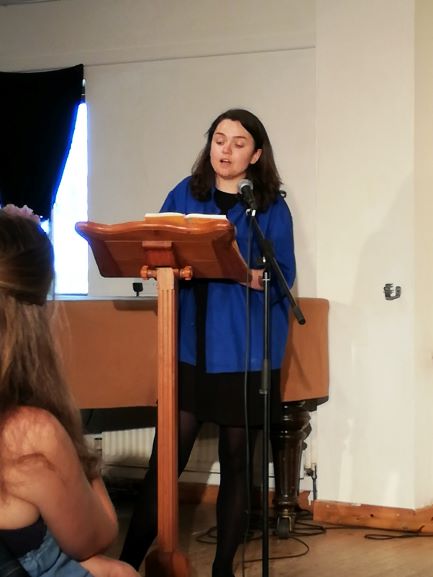
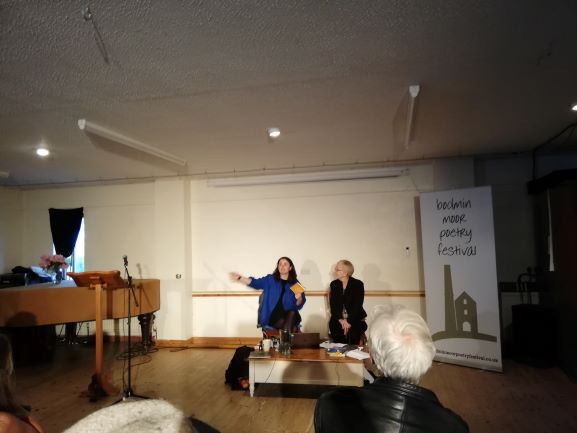
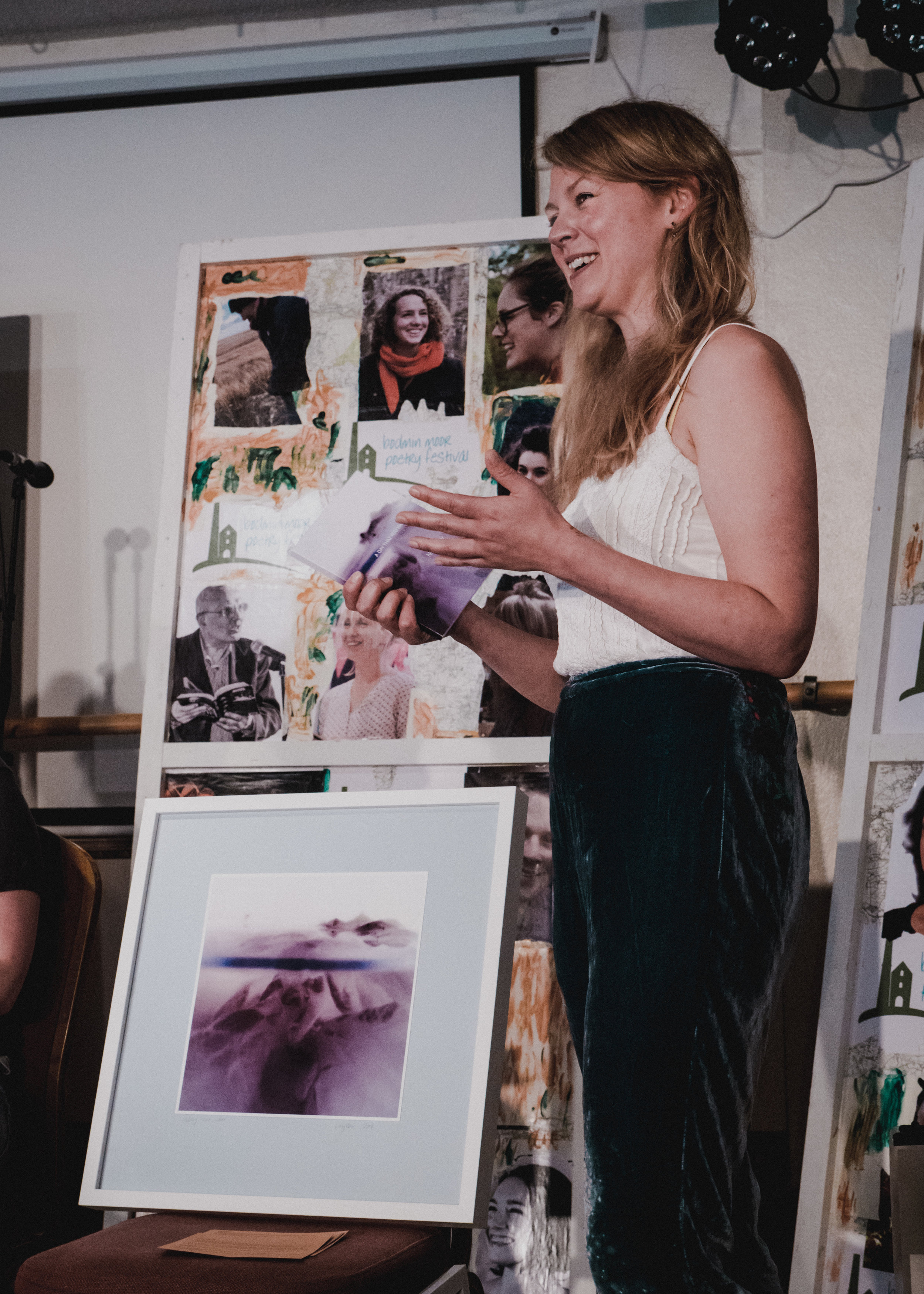
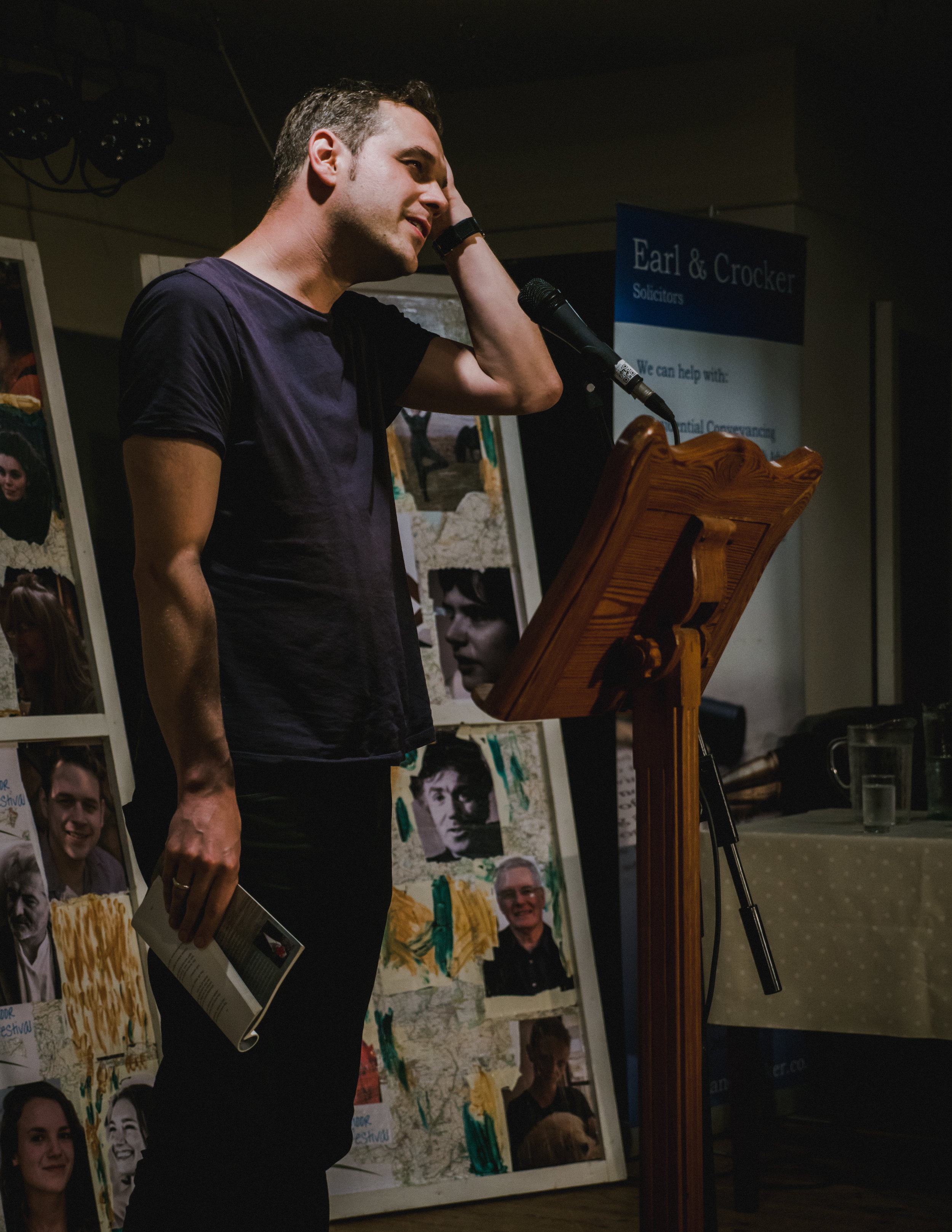
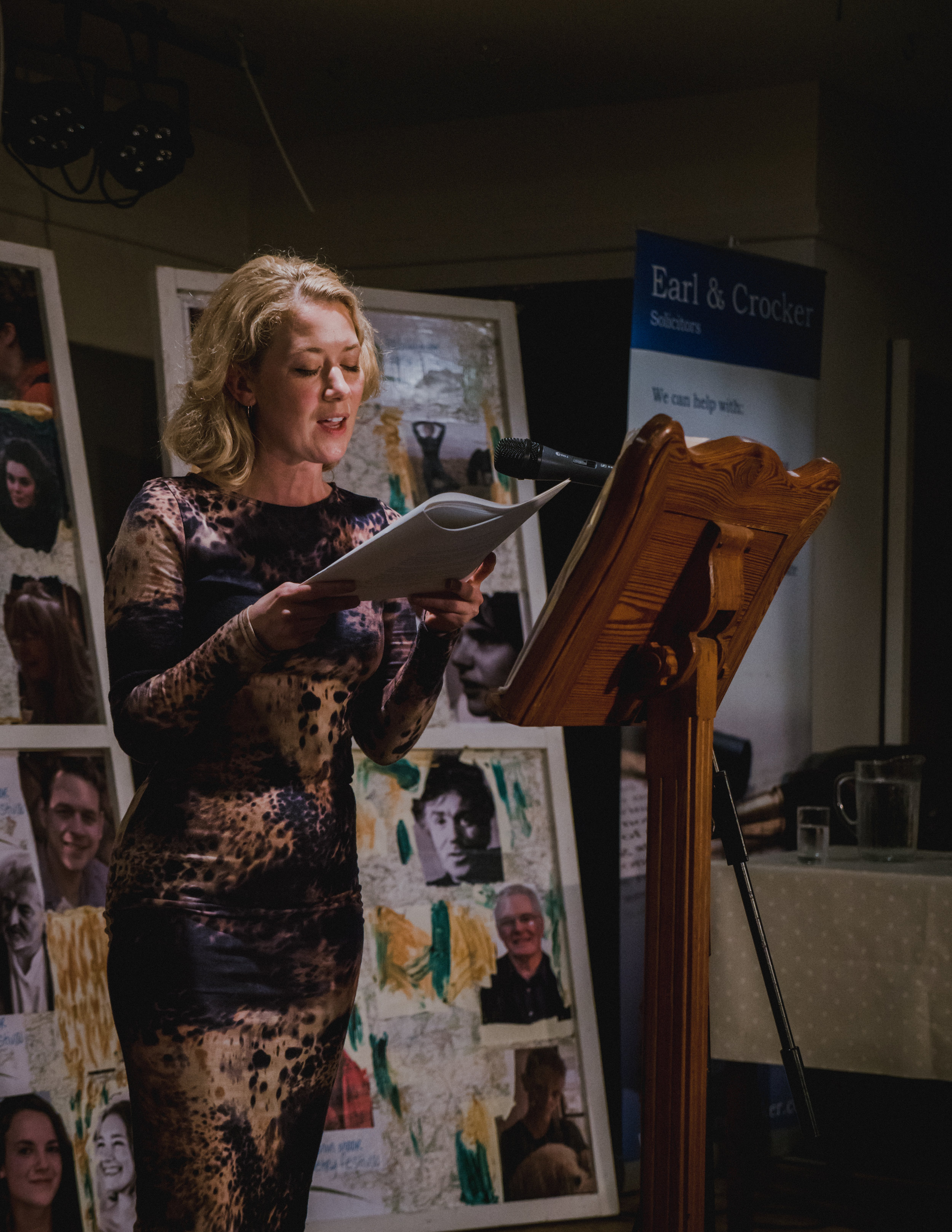
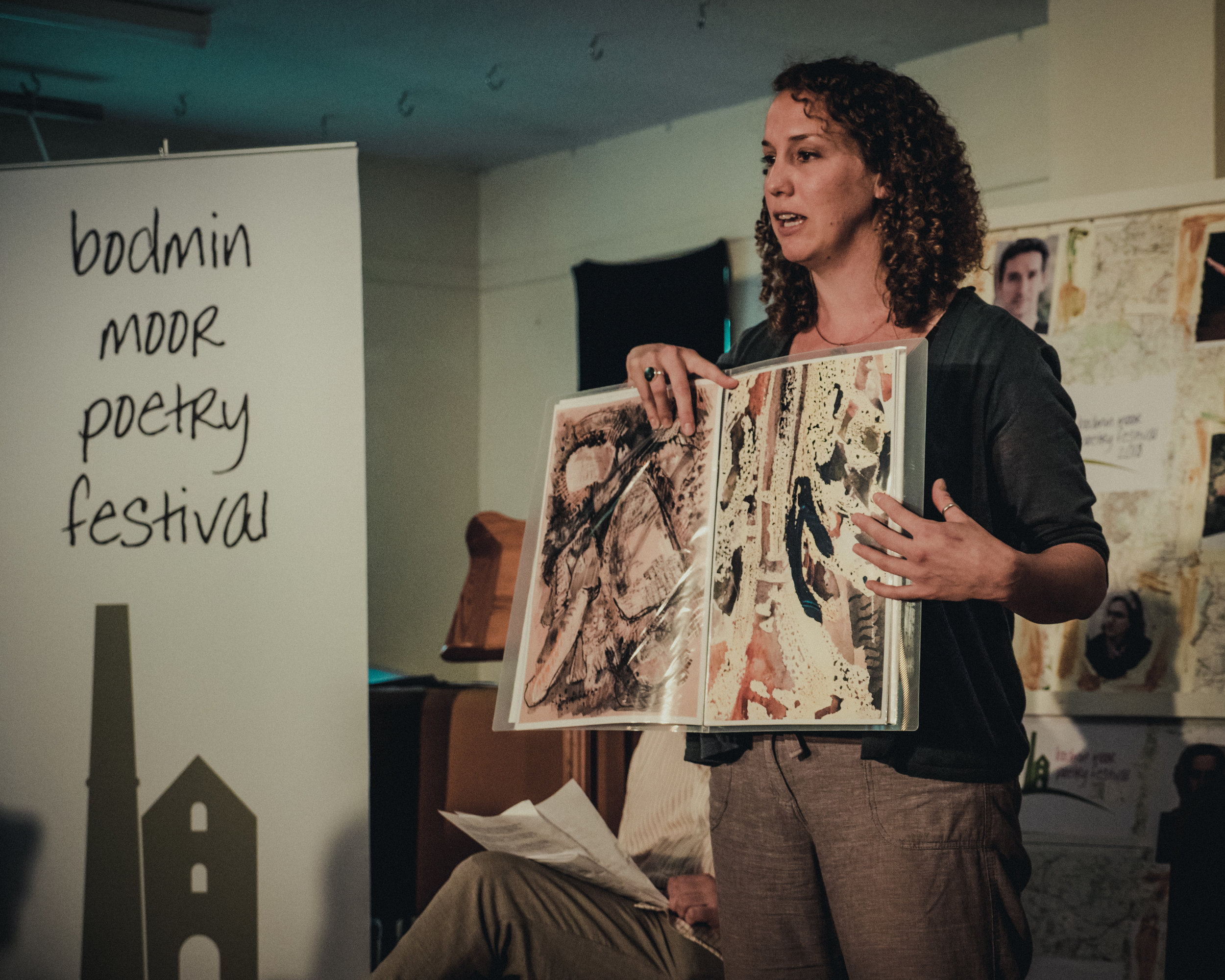
Two weeks have already passed since the first of two 2019 Bodmin Moor Poetry Festival events took place at Sterts Theatre, Cornwall. This was our second year co-curating (more on the first year here) and we have some photos from the day, so please take a look below.

We themed the day around ‘conversations’, pairing poets up to read from their work and talk about it. The pairings were: Jen Hadfield and Isabel Galleymore; Mona Arshi and Gillian Allnutt; Fiona Benson and Ann Gray; Rae Armantrout and Rachael Allen.

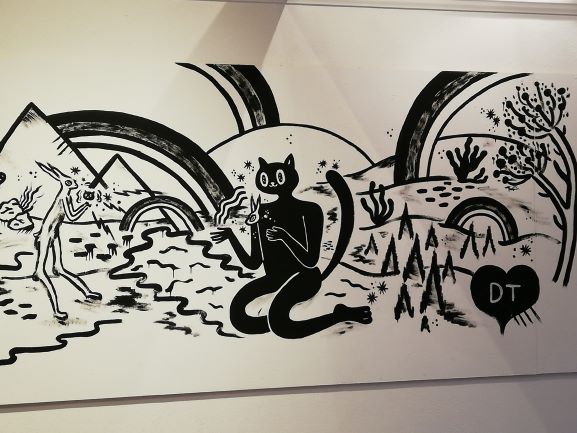
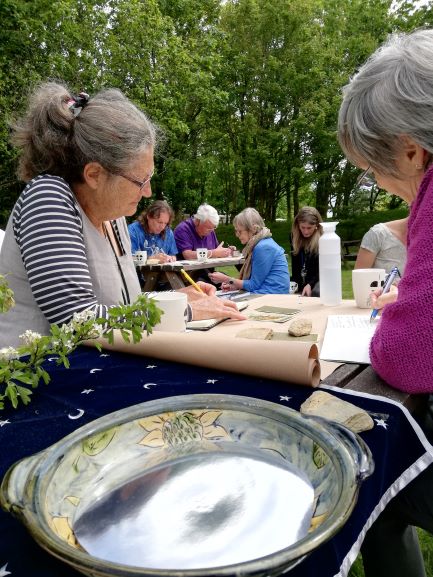
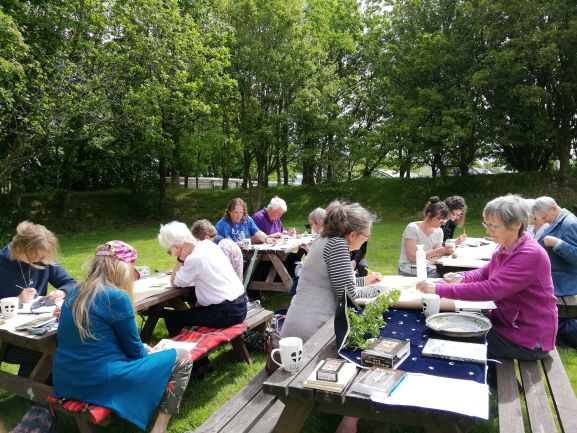
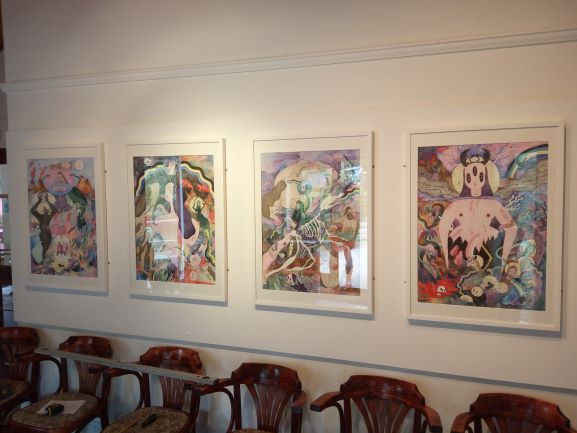
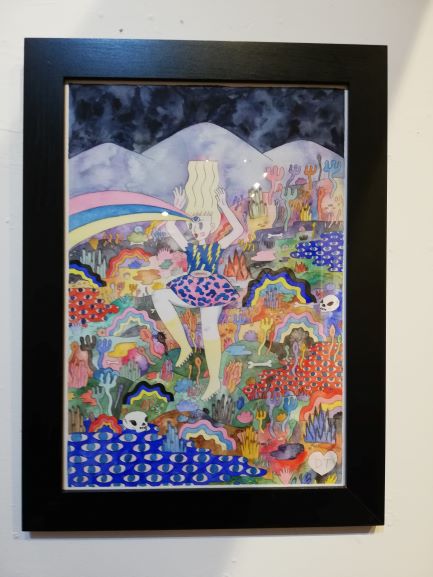
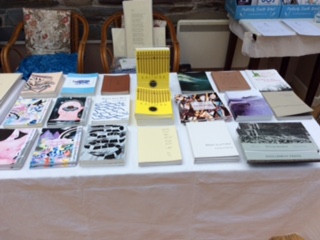
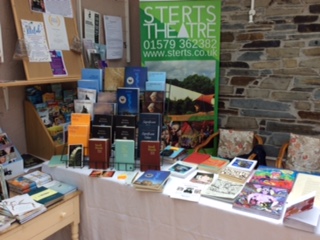
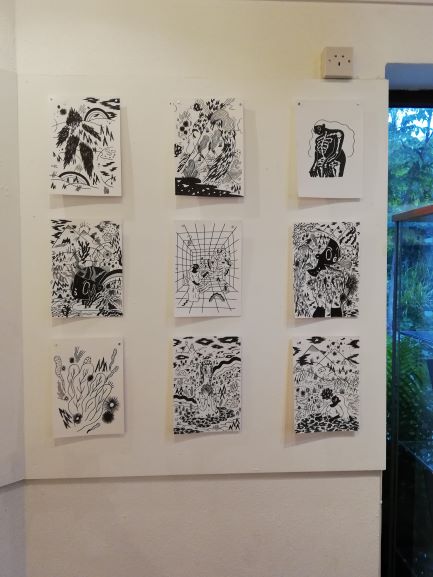
On top of the conversations we had a launch performance of Petero Kalulé’s Kalimba involving half a dozen instruments, a workshop on poetry and mysticism with Sarah Cave, and an exhibition by the artist Donya Todd. We also made a special very limited edition letterpress print of a new Jen Hadfield poem for the festival, printing it with Alan Qualtrough and Jen at Alan’s studio in Plymouth the day before. The festival’s poetry shop was provided by Amanda at Lost-in-Books.

The conversations were really interesting, highlights including Rae Armantrout on language poetry and ecology, Jen and Izzy talking about scientific language and anthropomorphism, Mona and Gillian on working with refugees, and Fiona and Ann’s beautifully curated journey through their own and one another’s work. Petero’s improvisation of Kalimba is always great to see, and as there was a piano in the Sterts studio he incorporated that, too – playing it conventionally, then plucking and hammering the strings and case.

If you have any more photos from the day please get in touch, and stay tuned for news of the second event in September, which is shaping up nicely...

Publisher's Diary - Letterpress printing Jen Hadfield's 'Notice'

When the poet Jen Hadfield was resident in the Charles Causley house in Cornwall we went for a walk to St Clether’s holy well chapel on the north-eastern edge of the moor. It was following this walk that Jen wrote the poem Notice, which we letterpress-printed on 24th May in an edition of just 30 for the 2019 Bodmin Moor Poetry Festival.


The Chapel

To get to the well chapel you wander through the churchyard of St Clether and along a path in the hillside above the River Inny, the way marked by a wooden cross.

The saint to whom the well is dedicated is essentially unknown, although most websites say that Clether was founded by one of the dozens of children of the 5th century Welsh King Brychan; a son named Cleder or Cledrus, who followed his brother Nectan to Cornwall. Others say that Clether was the 1st century Bishop Cletus, a Roman who became the third pope. Another associates Clether with the 9th century Mercian warlord Ethelred, and we might as well add his contemporary and namesake, Ethelred the King of Wessex, to the list of (im)possibilities.

The current well chapel was built in the fifteenth century on those ancient foundations and has been renovated numerous times, including by Sabine Baring-Gould at the end of the nineteenth century.

There is a fence around the chapel grounds, with a wooden gate. Bird feeders hang empty from surrounding trees, and there is a rough wooden bench along the south wall. The original well is outside the chapel with a hawthorn tree above it hung with clouties. The well water has been channelled to run into the chapel along the east wall behind the altar, past a nook carved where it is thought a relic might have been kept, and out into a second well in the south wall, which can be accessed openly from outside, or by a little wooden door from the inside of the chapel. This second well is decorated with stones, flowers, ribbons and shells, left as votaries.

The ancient altar and the window behind it are covered with foliage, as well as candles, a crucifix and a feather. There are twisted-wood wands and staffs for sale, and a strange book of short stories about the well’s priestess and wise women ‘guardians’, written by the current ‘guardian’ Vanda Inman.


The Letterpress

The day before the Bodmin Moor Poetry Festival, Jen and I went to Alan Qualtrough’s Kiss & Bite letterpress studio in Plymouth. The studio is in two parts, the first full of type drawers, an old treadle press and his favourite Adana (there are further Adanas tucked away in various corners). This is where we set the type, one stanza at a time in the composing stick, upside down and backwards, which Alan then transferred to the chase. The setting took more than two hours, a slow process that forces you to consider the placement of every letter and space within every word and every line, connecting you physically to the language and to the poem in a unique way.

This slow, deliberate process is at the heart of Alan’s practice and his research on the connection between the letterpress printing method and truth. Alan contrasts the investment (physical and temporal) in letterpress publishing with the throwaway publications of social media posts.

The second part of the studio is where we printed the poem on Alan’s favoured FAG (Fourniture pour les Arts Graphiques) letterpress bed. We inked the type by hand, rather than using the letterpress’s automatic rollers.

The test print showed that we had placed the letter ‘g’ upside down and that my name had been spelled ‘Lwke’ (a ‘w’ presumably having migrated to the wrong section of the type drawer), so we needed to dismantle a few sections and test again, taking care to ink properly and tweaking the pressure a little.

The whole printing process took about 5 hours – but that was before we had the card and protective cellophane cut (thank you Stable Arts!) and left the prints to dry a few hours. Jen then signed them and we packed up the poems ready for the festival in the morning.

‘Notice’ is set in Baskerville, with details in Caslon and Gill Sans. It is printed on two different stocks, Conqueror’s Laid Crème and St Cuthbert’s Somerset. We printed 30 copies for the festival and have just a few left. The dimensions are 42cm x 21cm They are all hand numbered and signed by Jen Hadfield and are for sale at £15. If you would like a copy please email us on editor@guillemotpress.co.uk.

 LT

Note: You can book letterpress training days with Alan at his studios. He’s a terrific teacher – patient, calm and enthusiastic – and we had great fun.


Publisher's Diary - Kalimba

If you haven’t seen it already, check out Kalimba. We’re really proud of it. We’ve loved this book since we first received the text from Petero Kalulé.

It is one of the thrills of publishing to be among the first to read a manuscript, and publishing debut poets is just the best. Petero’s Kalimba joins a string of fantastic debuts – Amy McCauley’s Oedipa, for instance, Nic Stringer’s a day that you happen to know, and Karl O’Hanlon’s and now they range – and we have lots more to come.

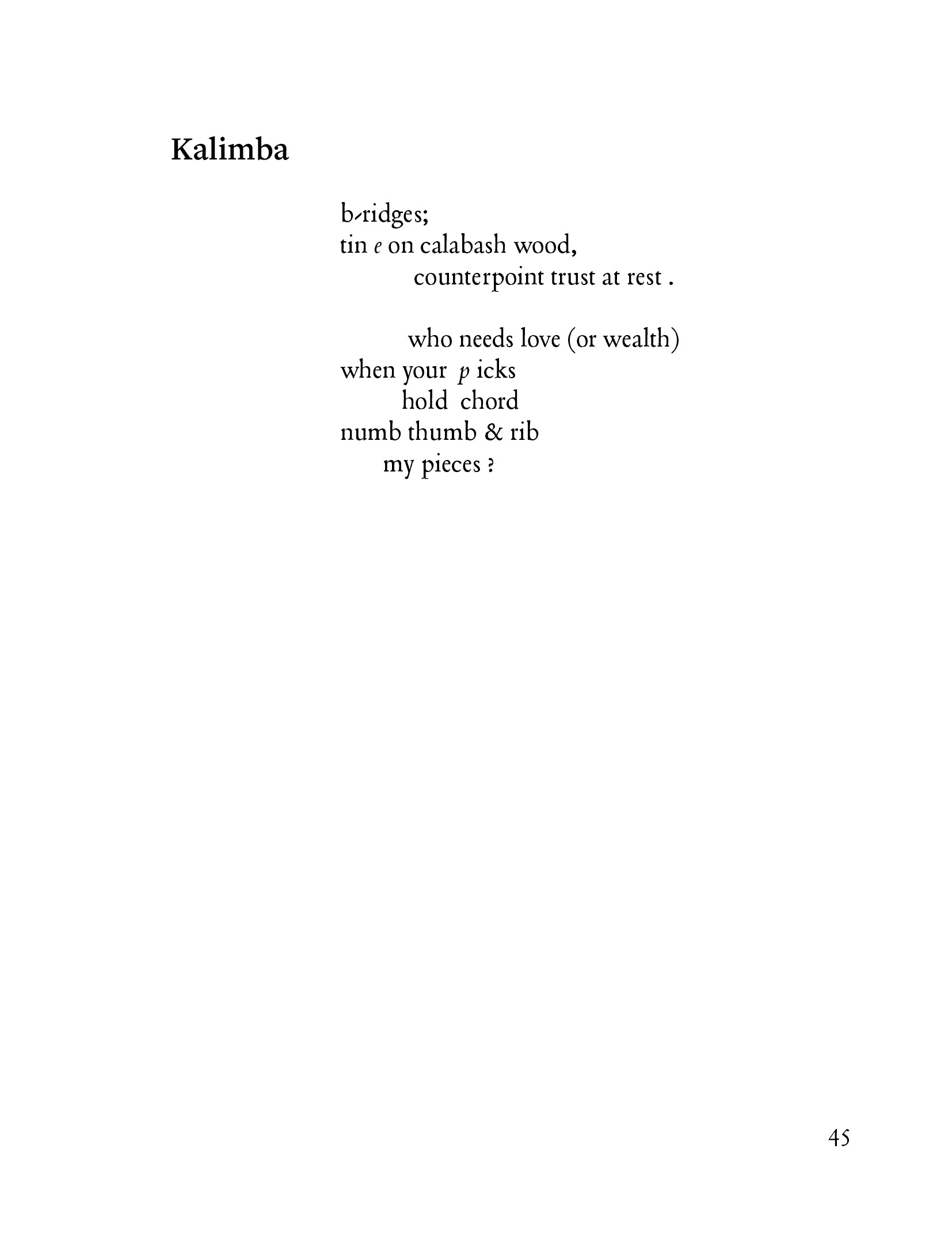
The poetry of Kalimba was immediately striking. It was playful, surprising and musical. It surprised us again when we saw a different iteration of the text, with Petero performing at Chener Bookshop in East Dulwich, reading the poetry like a musical score with flute, saxophone and bells.

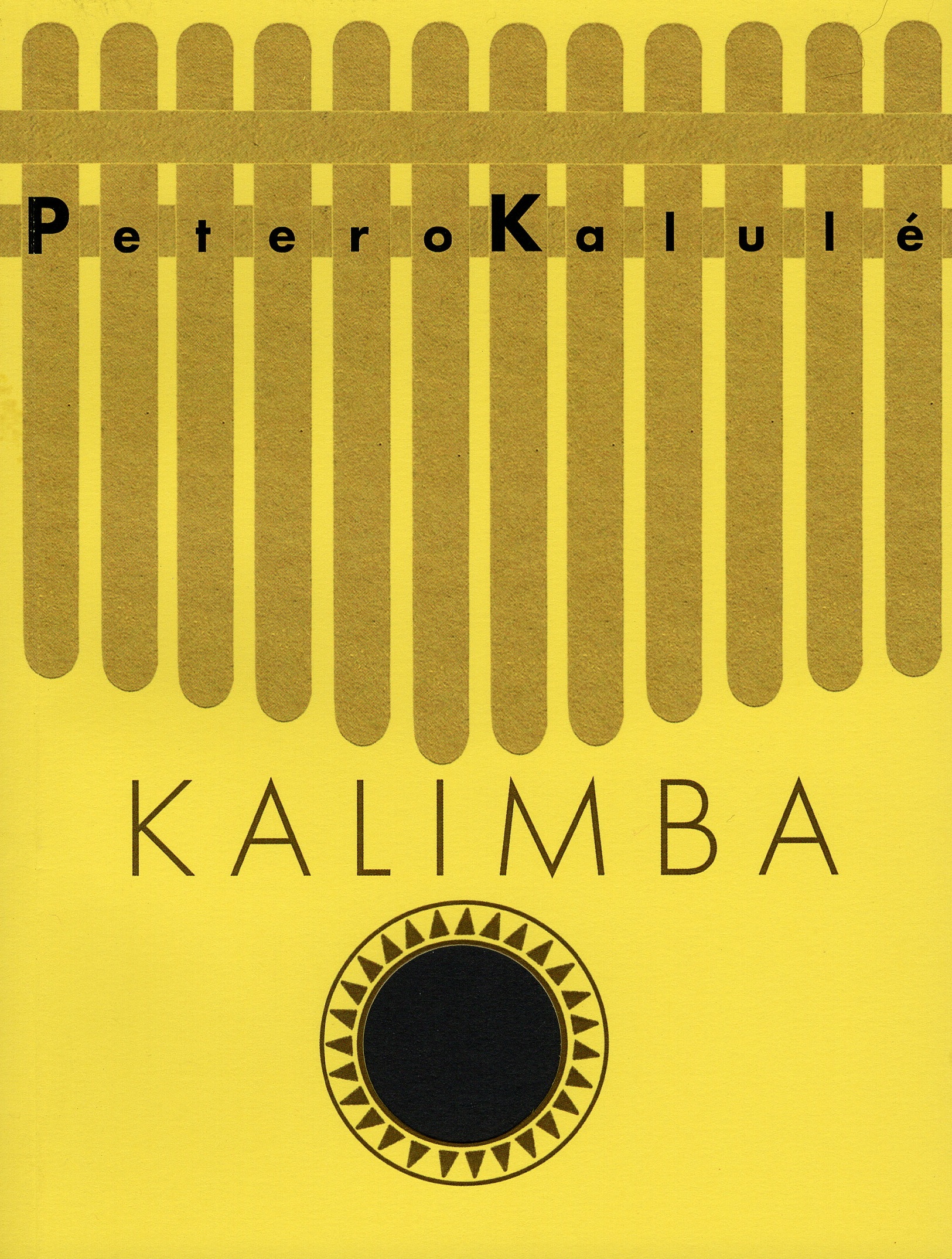
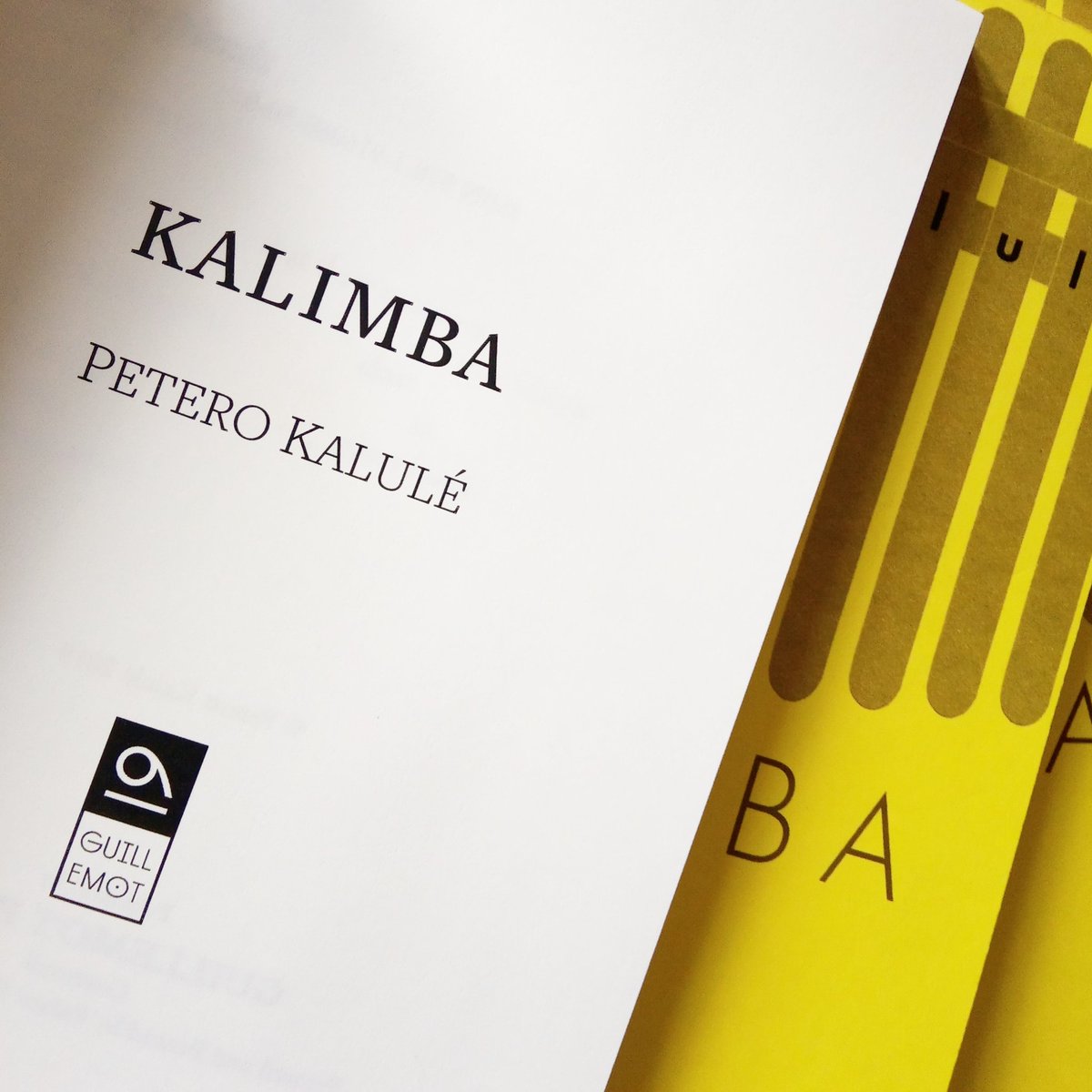
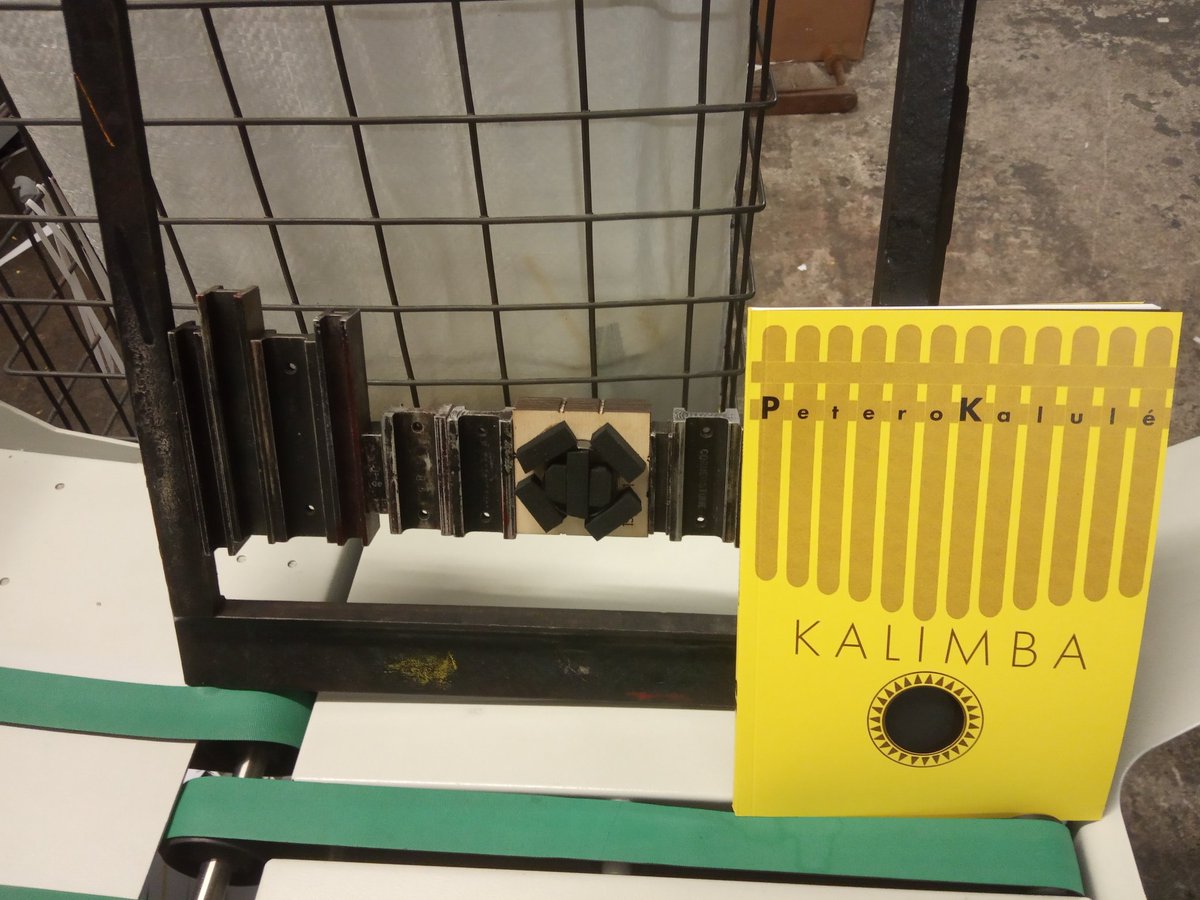
The cover image is by Ria Gunton, a young illustrator from Plymouth who has been creating a series of images for us this year, including for Rowan Evans’s The Last Verses of Beccan and a forthcoming title from Isabel Galleymore. You can see a little more of Ria’s work on her Instagram page and on her website (where you can buy yourself one of her yeti badges). The idea for this book was to turn the book itself into a Kalimba, complete with acoustic hole.

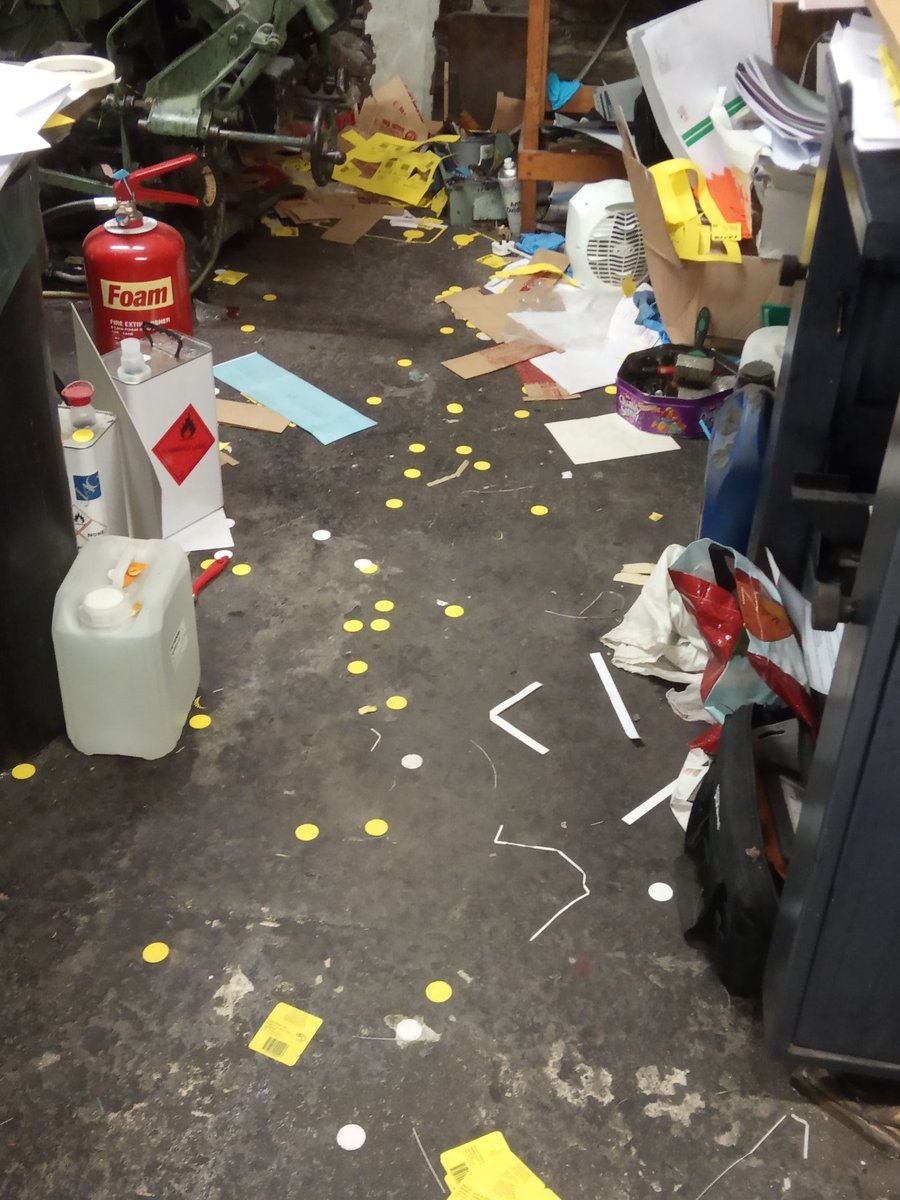
The ‘acoustic hole’ was cut out using a die and a 1920s Thompson letterpress. The process was not without its problems, but intriguingly the issue was not with the 90-year-old letterpress but with the modern digital printer, which was printing imprecisely and unpredictably. The wonderful old letterpress was hitting the paper perfectly each time.

Kalimba is having a couple of London performance and launch events in the following locations:

·       17th May, 7.30pm – Hundred Years Gallery

·       22nd May, 7pm – South London Gallery

These will be rounded off by a visit to Cornwall, where Petero will be taking up a short Roger & Laura Farnworth Arts Residency on Bodmin Moor and reading at the Bodmin Moor Poetry Festival on 25th May, with a line up that includes Rae Armantrout, Rachael Allen, Mona Arshi, Jen Hadfield, Gillian Allnutt, Isabel Galleymore, Fiona Benson and Ann Gray, as well as an exhibition by Donya Todd and a poetry workshop with Sarah Cave.

Some photos of the Kalimba publishing process are in the gallery below, if you’d like to flick through.

LT


Publisher’s Diary - The Last Hundred

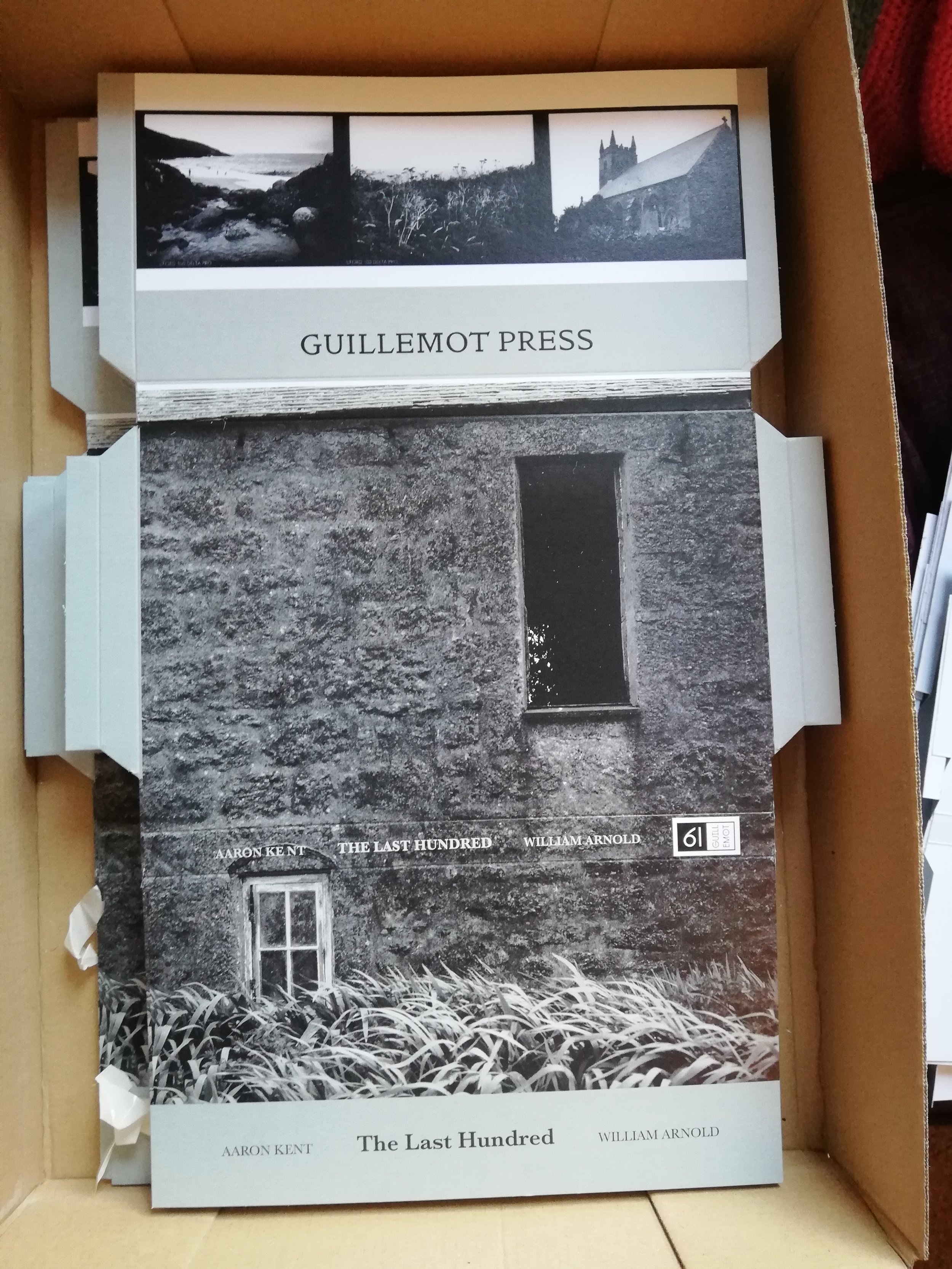
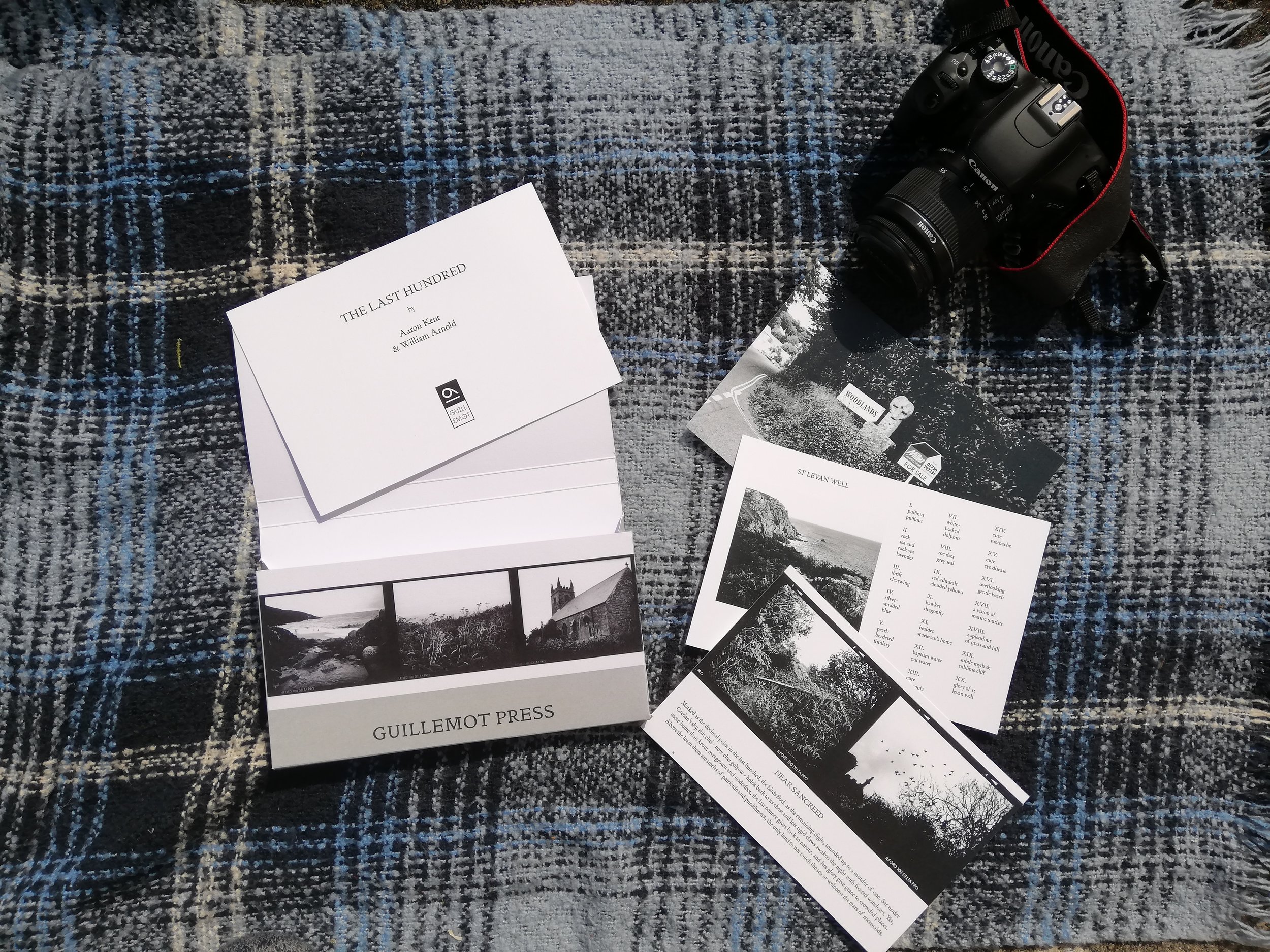
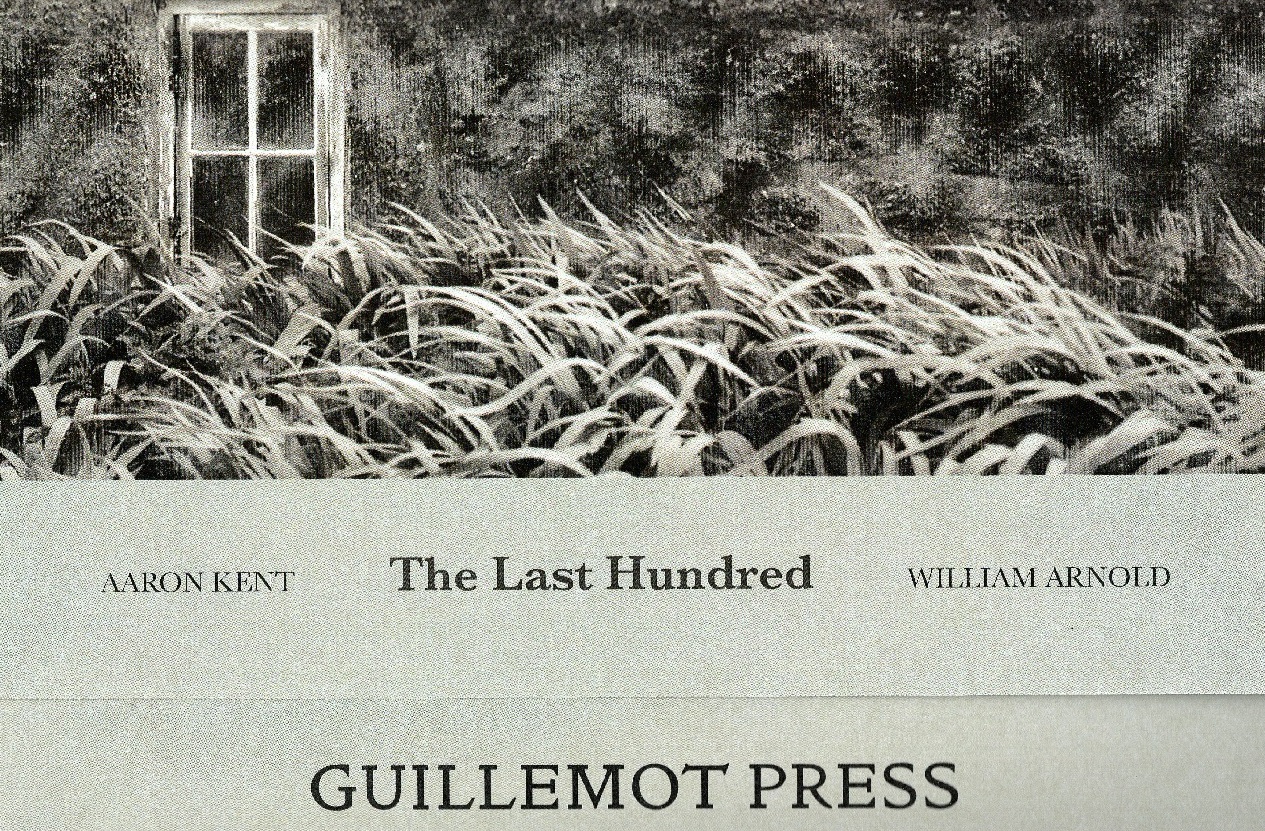
April’s new release is The Last Hundred by poet Aaron Kent and photographer William Arnold. It’s an exploration of the far West of Cornwall, using the old land boundary term of the ‘hundred’. Cornwall was split into nine Hundreds (Stratton, Trigg, Lesnewth, East, West, Powder, Pydar, Kerrier and Penwith) with Guillemot HQ sitting right on the border where four of them meet: Pydar, Trigg, Powder and West.

The Last Hundred is a collaboration that came to us fully formed, which is unusual for Guillemot. Most often we find our own artists if we want to ‘dress a text’ (to borrow Emily Juniper’s phrase), but this one (like our other poetry-photography collaboration, Carousel) came to us wonderfully complete.

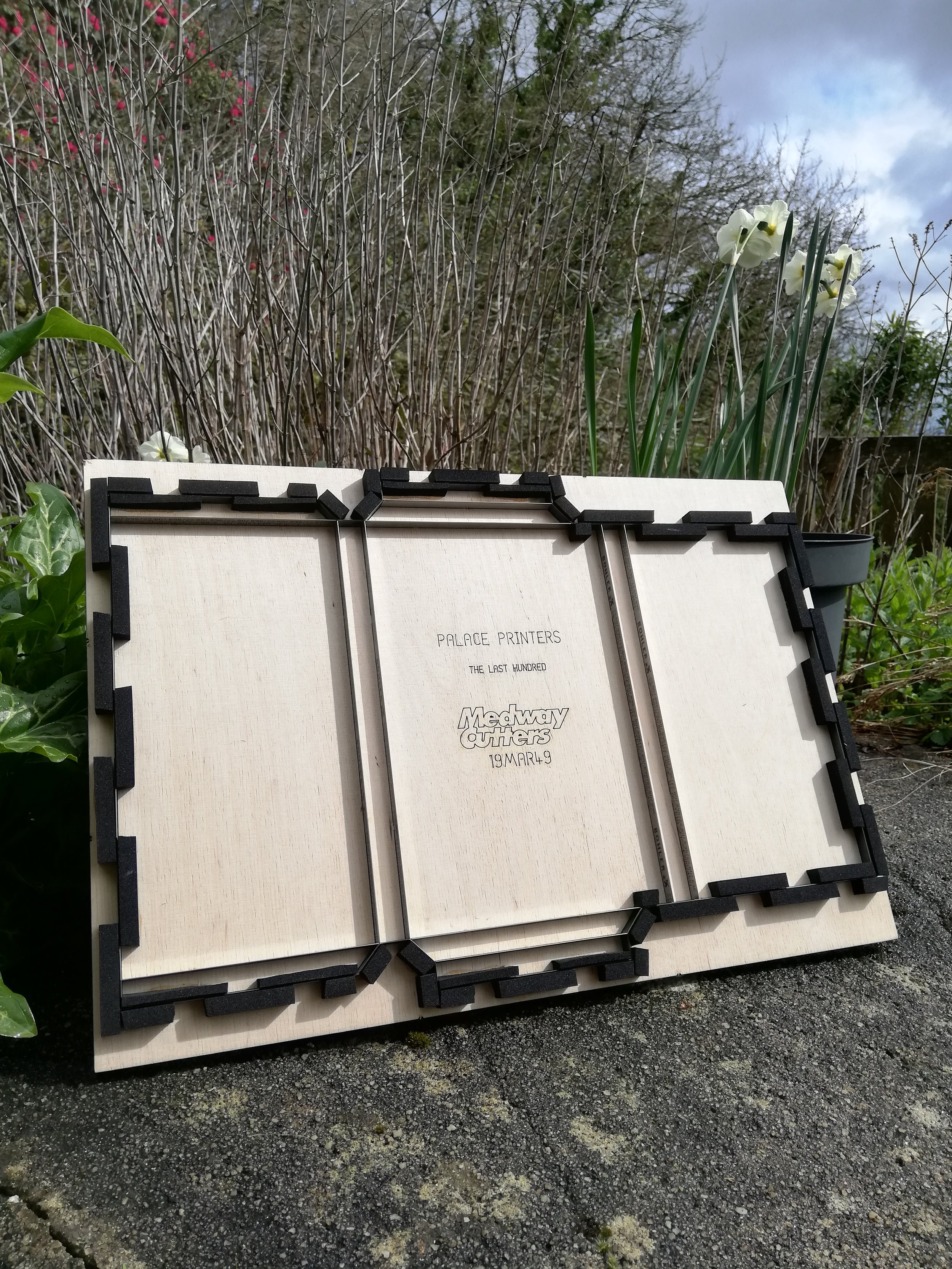
For the production, we have gone for an unbound book of poems and photos that come in an envelope, mimicking the kinds of envelopes photos used to come in when you took them to Boots for developing. This meant designing a template from scratch – a process of trial and error, mocking up lots of miniature test envelopes until it was right. It had to be over-sized and we wanted both ends to have a ‘spine’ so that it would sit well on a book shelf.

Once the design was ready we had a die created – a series of blades that cut out the template (see photos below) – and added score lines where the envelope was to be folded. The first few test prints did not work. The paper split, leaving nasty white scuff lines along the folds. Mostly, this was our choice of papers. We were using a lovely textured paper with a coarse grain – an exceptional stock that prints both text and images brilliantly. We would need something finer for the page to fold properly. More tests, more die-cutting, deeper score marks, more folding.

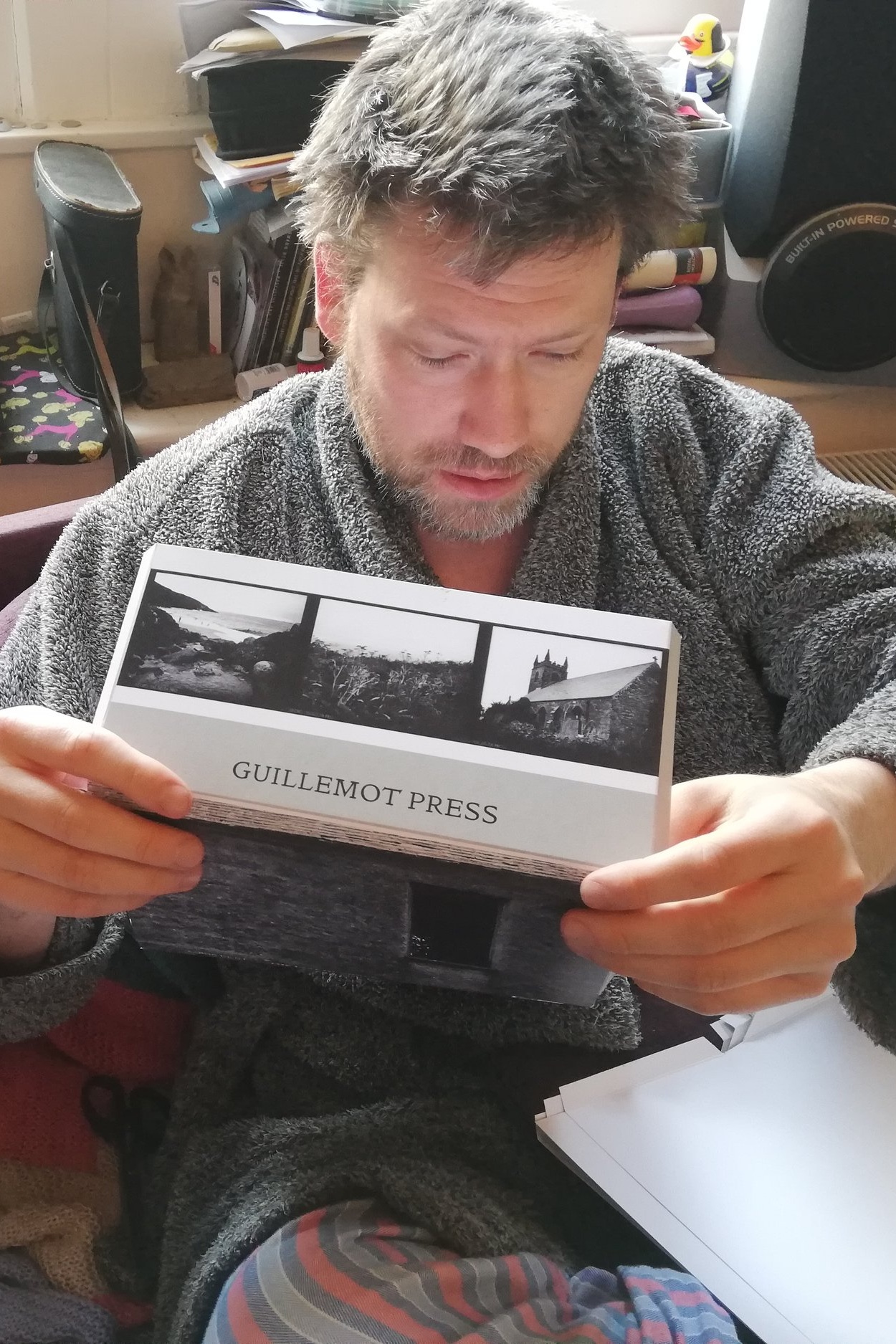
And so here I am, sitting in my pyjamas at 6.30am folding envelopes and collating the poetry cards ready for release. The first one took 25 minutes to put together and I have a pile of about a hundred to get through. A hundred Hundreds.

After the morning’s folding I’m off to see a man about a letterpress for another special little project…

LT

Bodmin Moor Poetry Festival 2018

This year Guillemot Press was invited to curate a day at the Bodmin Moor Poetry Festival. If you don’t know it already, BMPF is a little gem of a festival. It’s intimate, inclusive and always surprising, set out on Bodmin Moor at Sterts Theatre, near Upton Cross in Cornwall.

For us, it was an opportunity to invite some of our favourite poets and artists and we put together a list of established poets that included Thomas A Clark, Vahni Capildeo, Holly Pester, Luke Kennard and Holly Corfield Carr, as well as some excellent newer voices who are very quickly establishing themselves, including Elisabeth Sennitt CloughSarah Cave, Aaron Kent and Amy McCauley. Amy’s performance of Oedipa was staggering. We had the privilege of publishing Amy’s debut in May this year and to see it brought to life in this incredible, visceral way was so exciting. Amy will be giving Oedipa a Manchester launch on July 2nd. Do try to see her if you can.

But this was a day with so many highlights. Luke Kennard and Holly Pester were hilarious and intoxicating. Vahni Capildeo’s reading was beautiful, with poetry from recent collection Seas and Trees and from her newly-announced Forward shortlisted collection Venus as a Bear. Then there was Thomas A Clark, reading from his latest collection wing of the ptarmigan. The pace, the quiet and the meditative repetition of his reading was spellbinding. Tom had an exhibition in the theatre’s gallery, too, with fragments of landscape made from jigsaw pieces, a t-shirt printed with the words ‘and once I was a dragonfly for an afternoon’, and a series of cards and tiny publications. It was a fascinating use of a small space.

Then we had a panel of our wonderful illustrators, featuring presentations and conversation with Emily Juniper, Rose Ferraby, Phyllida Bluemel and Lucy Kerr. These are some of the artists we’ve been working with recently to produce illustrated poetry books of work by Amy McCauley, Melanie Challenger, Martyn Crucefix and Nic Stringer. Lots of themes and ways of approaching texts were shared among the artists, in spite of their styles and practices seeming so different. Emily’s sense of ‘dressing’ the text when she spoke of her Medea and her work on McCauley’s Oedipa was fascinating, as was Rose’s textures and geography, Lucy’s ambiguity and Phyllida’s sense of the many lives of the poem.

The day ended well into the night, across the road at the Caradon Inn. Memory is hazy, but the Guns N Roses karaoke and a drunken man reciting Macbeth at Holly Pester in the beer garden as a lightning storm approached were special highlights.

We were allowed to run the bookshop for the weekend, which was a greatopportunity to present a range of books by some of our favourite small presses, such as Clinic and Moschatel, as well as individual titles from further great small poetry publishers, like Sad Press, Periplum and zarf, and of course some of the bigger hitters, like Carcanet, Faber, Penned in the Margins, Seren and Shearsman.

Throughout the weekend we were helped out by a team of students from Falmouth University who deserve mention. The weekend wouldn’t have worked anywhere near as well without Adriana Ciontea, Rhianna Gibbs, Jamie Andrews, Izzy Nieto, Gavin Hedaux and Ceire Warren, while Charlotte Rayment and Seren Livie wrote brilliantly for the festival throughout the build up and Kevin Woodley developed and managed the Bodmin Moor Poetry Festival website. Thanks are owed to them all.

And this was only the day we curated. There was so much great stuff either side of our Saturday, all put together by David Woolley and Ann Gray. A regular feature of the festival is Rachael Allen’s ‘Poetry Cabaret’, for which Rachael brings down a host of poets for an informal series of short readings on the opening night. This year Rachael brought Zaffar Kunial, Daisy Lafarge and Calum Gardner. Elsewhere over the weekend were performances by Liz Berry, Mark Ford, Eilean Ni Chuilleanain and lots, lots more.

Now we’ve had time to recover we’re already thinking about next year…

(Photos courtesy of Francesca Sophia)

The Guillemot Factory

Guillemot Press is uncontainably thrilled to announce a new collaboration beginning in 2018 between Guillemot Press and The Word Factory. The Word Factory is the most exciting short story organisation around, as well as a fantastic developer of new writing talent.

2018 will be our first year working with Cathy Galvin and her team, releasing short story pamphlets from award-winning writers Jessie Greengrass, Adam Marek, David Constantine and Carys Davies.

What’s more, this 2018 series of story pamphlets will be illustrated by the artist and comic book maker Donya Todd. We have had an eye on Donya’s work for some time now and leapt at this opportunity to work with her.

Every new venture deserves a new logo, and this little beauty (above) was made for us by another exceptional young talent, CF Sherratt.

More news anon!

Congratulations Rose Ferraby. 2017 & the Michael Marks Awards

2017 was our first year entering the Michael Marks Awards and we were so excited that Rose Ferraby’s work for Melanie Challenger’s The Tender Map won the award for Illustration. The judge Sir Nicholas Penny commented that Rose’s ‘bold semi-abstract drawings arise from and interact with the metaphors in the poems … in a highly original way.’ Rose herself said, ‘I wanted to create marks and forms that echoed the characters of places, while the combined use of graphite, conte, wax and watercolours allowed textures to develop.’

From a publisher’s perspective, the pairing of Rose and Melanie Challenger was a natural one as they have shared many of the same landscapes, in Cambridgeshire, Scotland and Yorkshire. ‘Melanie’s language tapped into my own memories of places’, Rose said.

The award ceremony was held at the British Library and was excellently organised. Photos were taken, including of Rose receiving her prize, but it turns out photos aren’t what Guillemots do best. In most of them Rose is a barely identifiable fuzz. (Maybe we were too busy clapping.)

When Rose was in charge of the camera, we managed a few better photos of fellow award-winners Charlotte Wetton (Poetry Award) and The Poetry Business (Publishers’ Award), as well as some of the short-listed poets (congratulations to Alyson Hallett, Phoebe Stuckes, Theo Kwek  and Natacha Bryan). Testament to how well all the poets read, the pamphlets were sold out by the time we got to the stall.

We’ve had a great 2017 and have a big 2018 planned too, with exciting new poetry from writers both established and new, as well as new fiction, exhibitions, collaborations, festivals and lots more . Details will follow in the New Year. Have a Happy Christmas everyone!

Autumn 2017

This November we’re celebrating the launch of our autumn titles with Andrew McNeillie, Martyn Crucefix and Nic Stringer, and a pop-up exhibition by artists Phyllida Bluemel and Lucy Kerr. This is a chance to meet the writers and artists of our very latest titles, to pick up your copies and get them signed, and to hear all three of our poets reading from their new Guillemot Press collections. Entry is free and we look forward to seeing you there.
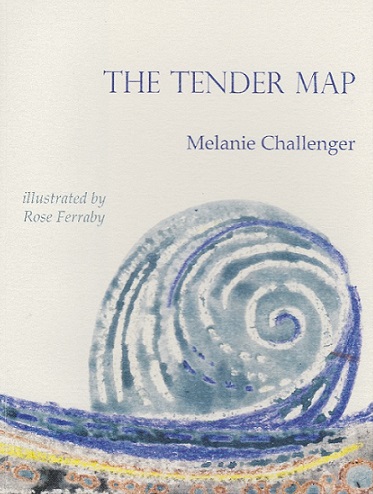
11 nov PB poster_ (2).jpg

O. at the Edge of the Gorge. Part Two, by Phyllida Bluemel

I have a print-out of O at the Edge of the Gorge covered in pencil scribbles and tiny indecipherable thumbnails of visual ideas. Putting images to poetry can be daunting. I find that, armed with a pencil, a close reading of the text and lots of doodling is a good place to start. I thought a lot about the point of illustrating poetry – what the images can bring. I want the illustrations to be in conversation with the poem, rather than just replicating images already present in the words. Starting with an intuitive visual response is a nice way to get the conversation started.

For me the poems read like an unforced train of thought – a notebook in the pocket of a traveller, a sun-drenched jotting of linked observations and associations and memories – the kind of meandering thoughts that are particular to a slow and hot afternoon. They are very evocative of place.

I was taken with the formal playfulness of the poems – the crown of sonnets – where emphasis repeats and changes and each poem flows effortlessly into the next. An enacting of Martyn Crucefix’s line “he snaps them sketches then revises again”. It seemed appropriate to echo that in the imagery. The folded and interrupted illustrations bind each poem to the next. I wanted to give myself some of the constraints that the poet had set himself – and nearly every image contains an element of the one before, re-appropriated and carried forward – a visual game of Chinese whispers.

The poems move from one image to the next but there are the same preoccupations – the specks and the flocks and movements alongside monuments and geology – contrasting contexts of time, and the sense (especially given the form) of something trying to be ordered or sorted out, but not quite complying – “dicing segments of counted time…” The diagrammatic, map-like – but not-quite scrutable imagery is a response to this – an attempt to make sense of forms and information, or grasp a particular memory and note it down. Not quite successfully. We are left with a string of related thoughts and a measuring or structuring impulse.

The imagery itself takes its leave from the words – an outlined lavender stem becomes a cross-section, a contoured landscape, which in turn ends up as the outline of a branch, twisting into the form of the river at the bottom of the gorge. I had a lot of fun playing with scale and the way in which lines taken from nature mimic each other. This felt right because of the shifts in perspective in the poetry – from the raptor’s eye view, to the ‘snufflings’ and ‘scratchings’ of detail. The buzzard’s diving and ‘zooming-in’ of the landscape. 

The use of newsprint for the folded pages is as much an act of ‘illustration’ for me as the lines. Maps and diagrams and lines interrupted by folds and the edge of the pages make it feel as if they are part of something else – ephemera or a dog-eared map folded, or a napkin sketch ­ – tucked between the pages of a notebook. I also think it’s OK to want to make a beautiful object for the sake of a beautiful object – the tactility of different paper stocks, the small and pocketable size of the book – all I hope lend themselves to a thoughtful reading of the poem.

O. at the Edge of the Gorge. Part One, by Martyn Crucefix

The scraps and scribbles that eventually became O. at the Edge of the Gorge are contained in a notebook dating from March 2014. The first words that made it into the finished sequence record my sighting of “6 white doves / on the boundary wall / looking away”. I’m pretty sure I spotted the birds on the drive to one of the airports north of London as, on the same page, sits a note recording a tannoy announcement calling a customer back to one of the shops in the Duty Free zone: “please return /  to Glorious Britain / for a forgotten item”. These are the sorts of strange happenstances that get thrown down in a writer’s notebook; happily, it was the dove image that stayed with me.

The landscape of the poem is the destination of my flight that day, the Marche in central, eastern Italy. I was staying in a house close to the edge of a deep gorge, looking out to distant hillsides, several hilltop villages, their church spires, clumps of dark trees. The roots of the poems – any poem, of course – spread much deeper than is immediately visible. So earlier in the same notebook, I find I had noted a quotation from Schopenhauer (itself quoted by Dannie Abse in the May 2014 issue of the magazine Acumen): “Envy builds the wall between Thee and Me thicker and stronger; sympathy makes it slight and transparent – nay, sometimes it pulls down the wall altogether and then the distinction between self and not-self vanishes”.

A little earlier, there was another note. This was from a piece by Ed Hirsch in the magazine The Dark Horse. Hirsch quoted Simone Weil’s observation that “absolutely unmixed attention is prayer”. He went on to urge our attention ought be paid to the earth, not looking for something atemporal and divine. We need to cherish the fleeting and the transient, even in its disappearance. This is the particular project of poetry, he argued, and these are recognisably Rilkean ideas that were always likely to attract my interest. I have spent many years translating Rilke’s Duino Elegies and Sonnets to Orpheus. The Orpheus link took a while to re-surface in my mind in relation to the new poems.

One other notebook entry stands out. I seem to have been reading Bruce Bawer’s book, Prophets and Professors (Storyline Press, 1995), and in a chapter on Wallace Stevens he quotes Mallarme: “To name an object is largely to destroy poetic enjoyment, which comes from gradual divination. The ideal is to suggest the object”. It’s not necessary for a writer to fully grasp such scattered sources; they tend to be ripped out of context and appropriated for use. In retrospect, I seemed to be thinking, over a period of weeks, about the relation between self and other, the paying of attention to the transient world and the difficulty of maintaining such attention through the medium of language. All of this re-appears in the poems that make up O. at the Edge of the Gorge.

Also by this time – probably July 2014 – there were two strong poetic voices chanting in my head. One was from poems I was trying to translate by Peter Huchel, poems written in the highly censored context of the GDR in the mid 20th century. I find I’d scribbled down “his vision is up-rooted, deracinated in the extreme – a world where meaning has withdrawn (the jugglers have long gone) what’s left is iron, winter, suspicion – spies, the Stasi, meaninglessness – but the natural world persists”. The other voice was from the Ancient Chinese texts of the Daodejing which I had also been versioning for quite a few months previously and were eventually to be published in 2016 by Enitharmon Press.

In complete contrast to Huchel, the Daodejing’s vision is one of ultimate unity and wholeness achieved through such an intense attentiveness as to extinguish the self and all barriers. These two extremes seem to form a key part of the sequence of poems that emerged in the next few weeks, my narrative voice moving from a Huchel-like sense of division and isolation to a more Dao-like sense of potential oneness.

Besides all this, I was playing in the notebook with the idea of ‘off’’. The point was, rather than focusing where the ‘frame’ directs us, we gain more from attending to what lies beyond it; the peripheral, I suppose, in a kind of revolt. I was muttering to myself “locus not focus”. I was thinking of the lovely word ‘pleroma’, a word associated with the Gnostics and referring to the aggregation of all Divine powers – though, as with Ed Hirsch, I was not so much interested in the Divine. Pleroma is the totality of all things; something like the Daoist’s intuition of the One. I think such ideas gave rise – quite unconsciously – to the several swarms, and flocks, the “snufflings the squeals and scratchings” that recur in the poems. These represent the fecund variousness of the (natural) world to which we might be paying more attention.

The hilly landscape and the plunging gorge itself also seem to suggest (at first) a divided vision. The carpenter bees act as intermediaries – at first alien, later to be emulated. As the first rapid drafts of individual poems came, there was a plain lyric voice – an ‘I’ – in a sort of reportage, revelling in the landscape, its creatures, colours and sounds till eventually I had 12 sonnet-like pieces. One of the poems seemed already to allude to the Orpheus myth, the moment when he looks back to Eurydice and she is returned forever to the underworld. His mistake, in this version, was that he was seeking an over-determined, “comprehending grip on earth” as opposed to a more passive openness to the phenomena of the world (which Eurydice seemed now to represent).

At some stage, the narrating ‘I’ was switched to a ‘he’ and the ‘he’ began to feel more and more like a version of Orpheus himself (hence O. at the Edge of the Gorge). The change from first to third person also gave me more distance from the materials. It was on a later visit to read my own work at the Cheltenham Poetry Festival in the Spring of the following year that I heard Angela France reading a crown of sonnets. I blogged about it at the time and coming home it struck me that my sequence ought to take the same highly interconnected form. The 10th of my sonnets – precisely that moment where the Orpheus/Eurydice separation occurred – was expanded into two poems, absorbing some details about a parked car on a hill and others, also focused on transience, from Dante’s Paradiso Book 16. The final sonnet to appear picked up on some notes I’d made long before about seeing a hunting hawk rise up from the roadside clutching a mouse or rat in its talons. By this stage, the gorge, in its representation of the Other, had also come to be associated with life’s most apparent Other, death. The whim, or wish, or risky flight of my narrator to include or encompass the gorge itself became the poems’ hoped for goal.

Autumn Update

We’ve been running for eighteen months (‘running’ really feels like the right word) and as we prepare for the next season of titles I thought it might be an idea to offer an update on what we’re doing and what the coming year looks like. There are some exciting developments.


Firstly, we’re really pleased with the little books we’ve been making recently. Each title teaches us a new lesson, whether that’s about printing techniques, paper stocks, typography or design. And in every post we should express our gratitude to the printer for indulging our play – while making one of this coming season’s books we clogged up or blew up (yes, really) four of his machines. Thank you Roy, and sorry!

In terms of new titles, we have most of 2018 just about ready to announce, and even some of 2019. But first things first. This autumn we have four titles on the way, stylistically diverse and formally distinct. It’s been serious fun spending time with them and we can’t wait to launch them. They are:

Rosmarie Waldrop’s White is a Color
Martyn Crucefix’s O. at the Edge of the Gorge
Andrew McNeillie’s Making Ends Meet
Nic Stringer’s A day that you happen to know


It’s such a delightful mix of writers, both new and established. We’re very pleased to be able to present a new prose poetry sequence by the brilliant Rosmarie Waldrop, case bound in white cloth and very cleanly designed. This will be our next release in the middle of September. Rosmarie is one of the greats, with a life in poetry that goes back half a century. Next to that, we have a debut collection from Nic Stringer. This is an exciting prospect and we’re just finishing it now. It’s been illustrated by the artist Lucy Kerr, who has created a new series of ‘illusions’. Andrew McNeillie’s book is also a real pleasure to announce. Andrew has been a great supporter over the years, an experienced poet and a generous editor and publisher. His collection is hugely atmospheric, menaced by the sea and the night. And then there’s O. at the Edge of the Gorge by Martyn Crucefix. This is a sonnet sequence, elegant and intoxicating, and it has been beautifully designed by Phyllida Bluemel. The pairing of Martyn and Phylly has worked exceptionally well. (Publishers take note: you won’t find a more thoughtful or sympathetic artist and illustrator than Phylly.)

We are planning to have a launch event featuring readings by Andrew McNeillie, Nic Stringer and Martyn Crucefix, with an exhibition of work by Lucy Kerr and Phyllida Bluemel, on 11 November at Terre Verte Gallery in Altarnun, Cornwall. Please put it in the diary.

That will take us to Christmas and into 2018, when we will be bringing you new poetry from Amy McCauley, Robert Lax, Dom Silvester Houedard, Sarah Cave and Keith Waldrop, creative non-fiction by Wolfgang Hildesheimer (translated by Nicola Barnes), as well as an experimental essay on ‘liminography’ by Rob Dickens. And then we have a very exciting new collaborative development for the second half of 2018, as we team up with the UK’s leading short fiction salon, The Word Factory, to present a series of short story pamphlets by some of the country’s most interesting writers. We will be announcing the project, as well as the first four writers, shortly, but they are all terrific.

That should keep us busy, right?

IMG_8829.JPG

The Murmuring Guillemot 2017


This weekend Guillemot made our roost at Port Eliot Festival – and it was the soggiest Port Eliot we’ve known. The rain was constant, the mud was deep.

The plan was to make a daily newspaper, printing on a risograph with content provided primarily by ten talented students from Plymouth University. We started soon after nine each morning, tidying out the press tent from the previous evening and discussing what we had to cover that day, who was working with whom and how. Throughout the day the paper’s content was written, edited, illustrated, scanned, set, printed, folded and collated, and by midnight the following morning’s paper would be just about ready and packed for the morning’s distribution. 

It was terrific fun, thanks to the students and editorial team, but also thanks to the numerous visitors who came to see us throughout the festival. We had Guillemot friends like clinic’s Rachael Allen and Sam Buchan Watts, Mona Arshi, Hannah Silva (who contributed a sound poem haiku), Wyl Menmuir, Emily Barr and James Brookes popping in and out of the press tent, sharing poems and giving interviews, and we had contributions from the public. One of the most pleasing pieces we received came after we published a playful article about a monster sighting in the River Tiddy. The following day a boy named George came to the press tent to report his own sighting of the monster’s orangey fin breaking the surface of the river and of the marks in the mud where the creature had slithered in and out of the water.

The editorial team was made up of John Kilburn, Charlie Sherratt, Lucy Kerr, Sarah Cave, Ben Smith and Luke Thompson – all writers and artists – but the content came mostly from the students. We had five illustrators and five creative writers from Plymouth University reviewing, interviewing, observing, playing, making comics, posters and fake adverts, then helping to fold and distribute the paper. The five writers were Shauna Crewes, Sophie Holman, Ropa Mugadza, Caitlin Brawn and Laura Reinbach, and the illustrators were Sally Mullaney, Elizabeth Rackal, Lily Treseder, Jade Broadhead and Eloise Levien. They were a wonderful team to work with – lively, talented and willing, and delivering funny, clever content every day. It was especially impressive to see the young writers and artists develop through the festival. None of them (none of us!) had done anything like this before, but as the days went by, working from nine in the morning until midnight, the work got better and better and was being produced much more swiftly. 

We did have a couple of problems to solve along the way, of course, mostly practical printing issues. The first was the paper and came right at the beginning of the print. The all-pervading damp meant that the original paper would not pass through the risograph and we had to hastily ship in a heavier stock at the last minute (thanks Dave!). Then there was the paper folder, which should have folded and collated the paper in minutes. Except it wouldn’t turn on. We put in a late night call to the students for help. They dashed back and the tent was soon full of laughter and cider as they hand folded every page of every copy. Over the weekend, that would be some 6000 pages. From the tirelessness of Shauna and Caitlin to the impressive speed and breadth of Sally’s contributions, each student brought something different and extraordinary to The Murmuring Guillemot.

Everything we own is muddy, really muddy. Really muddy and really wet and covered in ants. The press tent, the computers, the desks, the risograph, the laptops, the ipads, the scanners and printers, the editor – all covered in ants… and mud.

We would like to thank and congratulate everyone involved for a great job.

Iona Notebooks Launch & Exhibition Preview


This Friday, 5th May 2017, we will be officially launching Kate Walters‘ Iona Notebooks at Terre Verte Gallery, Altarnun. Iona Notebooks is a collection of Walters’ painting, drawing and writing from her times on Iona.

The launch is an opportunity to meet Kate Walters, who will be giving a short talk on her work, and to get a preview of the exhibition that will be running at Terre Verte until the 27th May.

Launch and Preview opens at 5pm

Spring Sun

Light fills the house like a huge stranger
leaning in at the windows
and watching.

from Sun, by Jos Smith

The year is warming and guillemots are moving back into their cities along the cliffs. So while we’re being sociable, maybe we could have a little catch up.

Our first pamphlet of the year was Jos Smith’s Sun. We used our favourite Mohawk Superfine papers and found some lovely solargraph and pinhole camera images by Dave Wise for the cover and to frame the insides of the book. The cover title is subtly embossed, which has really lifted it. We’re very pleased. Have a look and see what you think.

To update you on the year’s publications, we’re already looking pretty full and busy, which is great, with work from both new and established writers and artists. Any day now, Kate Walters’ Iona Notebooks will be ready. This will be a limited edition art book, printed on Accent stock from GF Smith, and each will be hand numbered and signed by the artist. The book will be £12 and every order will come with six Kate Walters postcards, specially made by Guillemot Press for this edition. Instead of our normal dimensions, this book will be squared, giving the paintings, drawings and writing a little more space.

In terms of new poetry, I’m really excited to see what the crown of sonnets by Martyn Crucefix is going to look like. It is currently being illustrated with a book design by the tremendously talented Phyllida Bluemel. We hope to publish this early summer, soon after our triptychs are ready.

The letterpress triptych series is hugely exciting. Twelve poets, three poems each. Each triptych is printed separately in a limited edition of just 50 (plus 12, one each for the poets). They will be sold in box sets (price tbc). The work is all ready to go and we’re just trying to book time with the 1928 Thompson letterpress. The list of poets is astonishing. This year’s twelve are: Peter Riley, Mona Arshi, Toby Martinez de las Rivas, Rebecca Goss, Rowan Williams, Nathan Thompson, Sarah Cave, Isabel Galleymore, Thomas A Clark, John Deane, Robert Lax and Rupert Loydell. If you’re interested in this very limited edition letterpress series, please email us.

Later in the year, we will have a debut collection from Nicola Stringer, a new pamphlet by Rosmarie Waldrop, and a new collection from Andrew McNeillie. There are a handful of further titles we’re waiting to finalise, including an interesting avant garde German translation, some American fragmented minimalism, a visual poem sequence, and a little photography, perhaps.

In other news, our collection of machines we hardly know how to use is growing handsomely. The latest addition is a risograph. Photos to follow – once we’ve found a way of squeezing it into the nest. We would like to add hand and letterpress printers, and I spent a surprising number of hours contemplating guillotine trimmers the other night.

We continue to receive (and encourage) terrific poetry submissions, but I’d like to invite something weirder for a small imprint we hope to launch. So what do you have in the way of visual or narrative material on alternative cartography, lost worlds, or the monstrous? We love the edgelands, both literal and metaphorical, and these exaggerations of the places beyond those we know continue to intrigue us. If you have ideas, work or research you think might interest us, please get in touch.

Happy Spring to you all.

Winter Plumage

I, this bleak year of Januaries taste
twelve Augusts harvested

Sister Mary Agnes, Harvest

We have been at sea over the festive period, looking back to shore. 2016 has been a stormy year and the Christmas seas were choppy. A strange climate to begin such an optimistic venture as Guillemot Press.
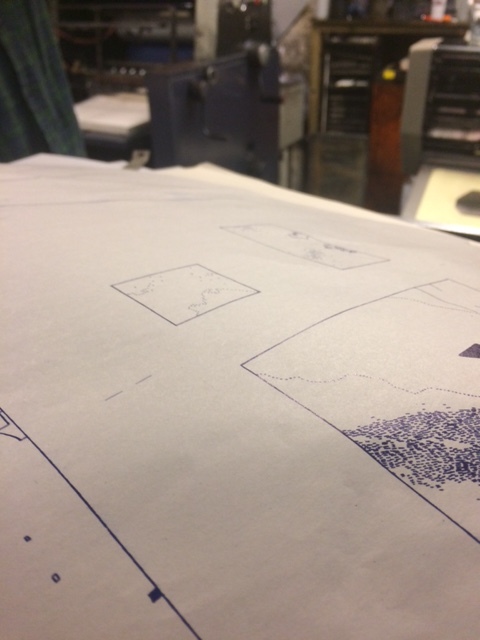
But here we are gazing at the cliffs of 2016 and grateful for the work we’ve produced. We’re pleased for the relationships we’re building, the writers we’re representing, proud of our first few books and excited for the year ahead.

In 2016 we published an exceptional new poet, Karl O’Hanlon, a beautiful forgotten poet, Sister Mary Agnes, and an exciting established poet, Melanie Challenger, as well as new prose from Rob Magnuson Smith and some revisited prose by Jack Clemo. We’ve had artwork from Tony Martin, Garry Fabian Miller, Rose Ferraby, John Kilburn and Kate Walters. We’ve had our first launch events and exhibitions, and the books (I hope) are getting better and better.

2017 is looking promising already, with new work due from Martyn Crucefix, Kate Walters, Jos Smith and Robert Lax, as well as a letterpress triptych series with 12 of our favourite poets, including Rebecca Goss, Rowan Williams, Mona Arshi, John F Deane, Peter Riley, Toby Martinez de las Rivas, Thomas A Clark, Rupert Loydell, Isabel Galleymore and Sarah Cave. The poetry of this series is brilliant and diverse, and the final two poets to announce (shortly) will further broaden the field.
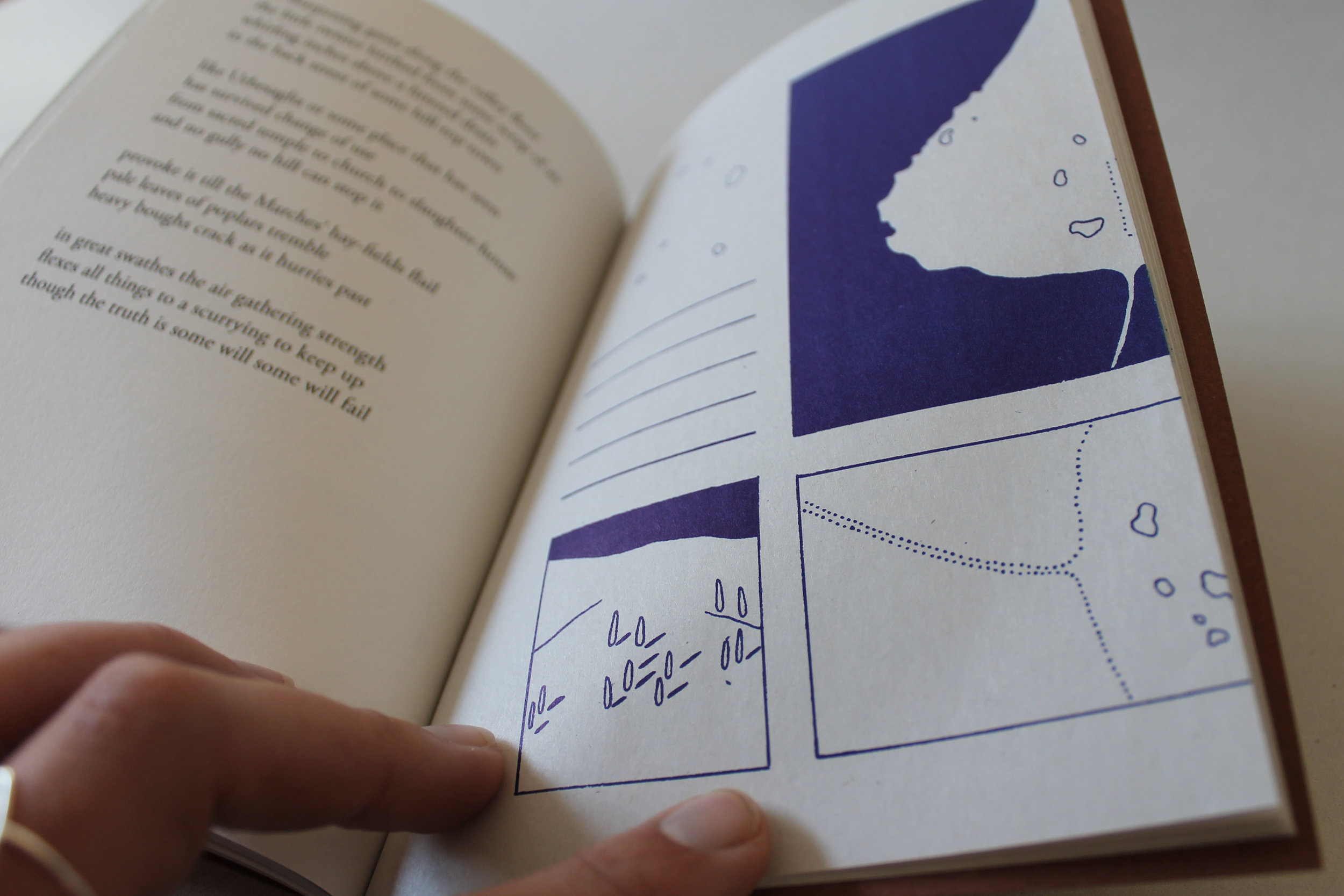
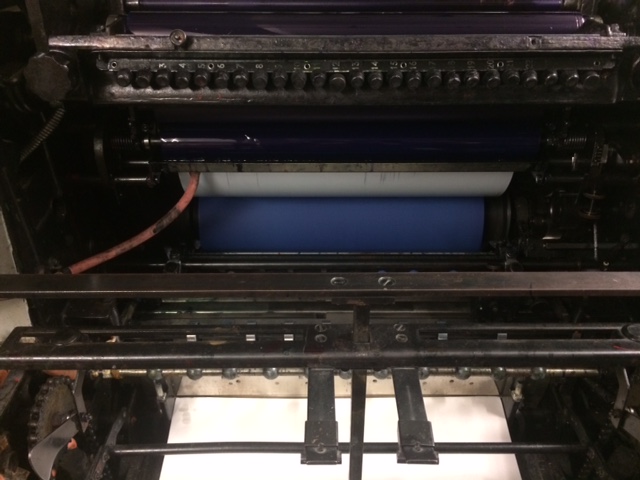
As well as these poetry titles, 2017 will see the beginning of a few rather different publishing projects, further books of beauty and wonder. More on this will follow soon.

Guillemot Press would like to thank everyone who has supported and followed us over this first year. We hope you’ll stick with us into 2017 and wish you all a Happy New Year.